
How To Build a Portfolio Career Without Quitting
My week is 60/30/10. AI makes it work.

I read a lot about the future of work. I read a lot about AI. Right now I’m testing both.
Most of my time goes to my fractional advisory work. The next biggest bucket, about 30%, is building a system for finding small businesses to invest/buy into (TBD if that will work out). The small bit left goes here, to this newsletter and the community I’m trying to build around it. Because I don’t have a 5-9 with 3 little kids at home.
It sounds like three different things that are hard to explain when someone asks “what do you do?”. It’s really one career but I dread the question.
The plan in business school, and during years in tech, was one path. Steady, clear, next steps, promotions, goals. So why do three things at once instead of staying on one very clear path? Because to me, this is what intentional living looks like at work (for me). It is things I care about, tied to what I’m good at, in a shape that fits the life I want to live.
And I keep meeting people who want something similar:
friends who were just laid off
the ones dreaming about leaving
the ones who feel a change coming (layoffs, RIFFs, yikes) and are hedging their bets
the ones on a path that looks amazing from the outside (but hate their jobs), who’ve had these ideas in their head for a while
Most are stuck for the same reason I was: believing the price of trying meant quitting. I DID quit. Part of it was that I couldn’t see what options were ahead of me, and the AI technology that makes testing possible wasn’t there yet, at least not in a way normal people could use. Both of those changed in the last 6-9 months.
So here’s what this edition is: what a portfolio career actually looks like from inside one, why AI makes it more possible, the exact AI tools I use in my week, and a step to test YOUR version without making any big shift. Also, this is what I wish I knew and had access to before actually quitting…
One career. The streams just take turns.
A portfolio career is a few income streams instead of one paycheck, built around what you’re good at and what you care about. Mine right now: one stream generates, one is neutral, one costs me money, on purpose, for now (hopefully - otherwise someone please stop me!).
For a long time I treated them like separate jobs I was juggling. This felt exhausting, mentally and physically.
I had it backwards. The streams help each other, and they don’t all have to pay at the same time (again - for now).
The advisory work teaches me, every single week, how real businesses run, which makes me sharper when I evaluate businesses. The search is teaching me how to think about risk, which shows up in my client work, and also puts me out of my comfort zone (cold calling, anyone?). And this newsletter started as something close to therapy (writing down what I was living through). For most of May my subscriber chart was completely flat. Then one morning last week I woke up to forty new subscribers. FORTY (okay you long time writers probably laughing at my 40 hype - I see you). Lagging indicators take their time. There’s no overnight success or one trick pony (spoiler alert - if you were hoping for one, this newsletter won’t give you one).
A meaningful career can be built a lot of different ways, tied to things you enjoy, in a shape that fits how YOU want to live. That’s what I am trying to (patiently) build. Each stream will have its moment, but AI is making getting there faster.
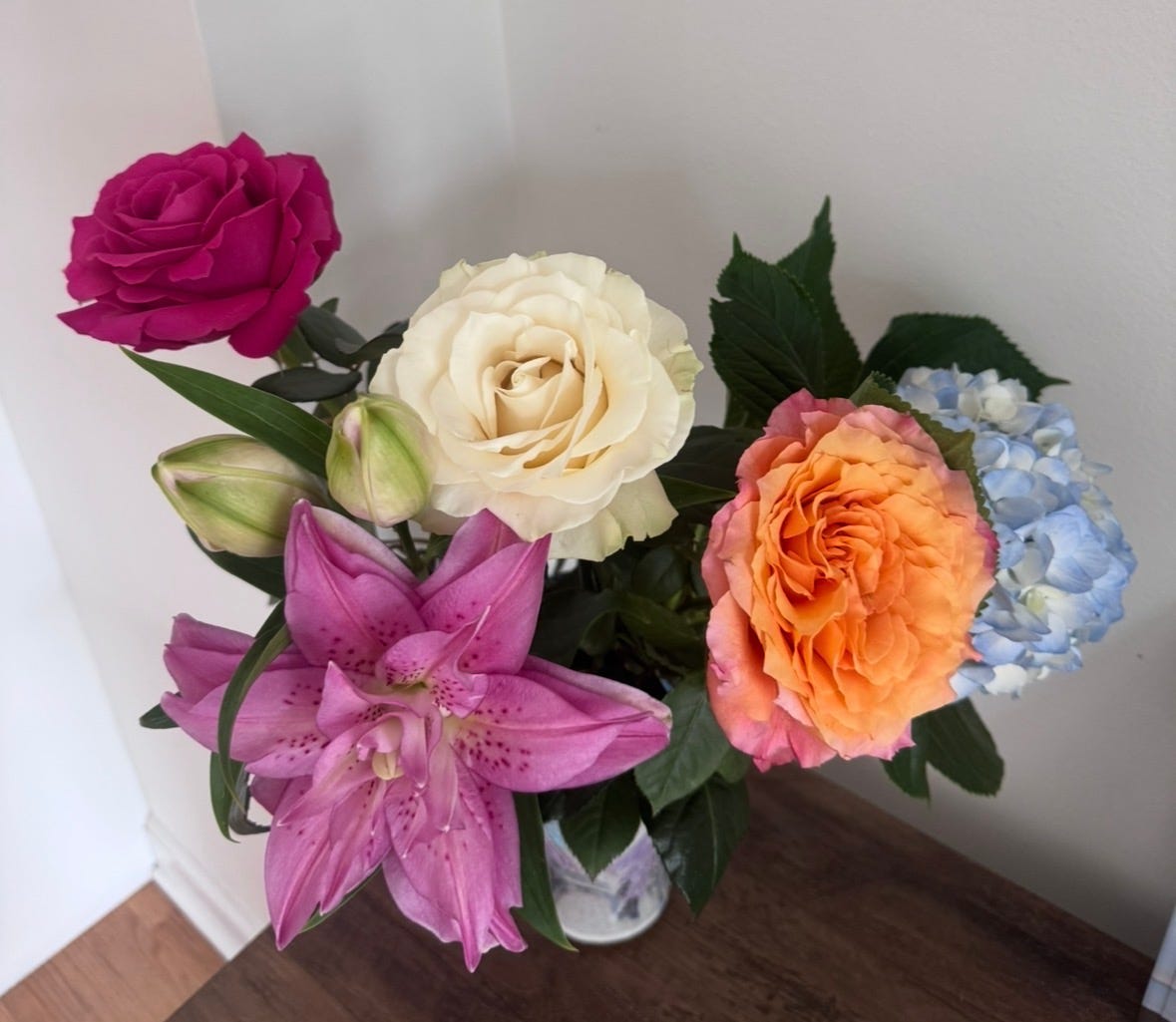
Reminder that different streams have their time to bloom. A portfolio career can be rich in color, but takes time and tending to (cue birthday flowers).
The AI manifesto the whole internet is talking about
Mark Zuckerberg recently published a 6,500-word essay called The Future Is For Everyone. Meta sells the AI agents he’s describing, and he will make a lot of money off of us if this future pans out. I also don’t think that makes him totally wrong.
Like this line: “People are starting to be able to manifest ideas themselves without having to raise money or build large teams.”
Or the jobs he imagines coming: “one-person product studios designing custom toys, furniture, or clothes; world builders and experience designers creating games, stories, and adventures.”
The one-person toy studio will happen at some point. The first line is already happening. I see myself and a lot of others in my bubble trying it every single day, in the things I’m building and the things I watch other people build.
I went deep on the old playbook (I’m still in it)
The internet’s favorite answer to “how do I stop depending on one paycheck” has been to buy a boring business, where they promise cash flow and no glamour. I’m setting up a proprietary search funnel for exactly that RIGHT NOW. Whether it works out is TBD, and I’m still not totally sure it’s the right path for me.
So believe me when I say buying a good business is still a legitimate path, especially in an industry you know and love, and even more if you layer AI on top of the experience you already have. Big opportunity there - yes. It’s just becoming more competitive. Prices are higher. The thesis is still there, just not as strong as it was. And there’s another path a lot of people are starting to look at next to it.
FYI, one thing that’s really scary about buying a business on your own: you usually have to take a personal guarantee, which is a fancy way of saying the loan puts a lot of your assets, like your actual house, at risk. Very, very scary.
Earlier this summer I signed an NDA on a business I’d been excited about on paper. That one action, taking the next step, looking at the business, analyzing the financials, imagining myself in that seat, gave me more insight than any analysis I could have run in Claude. My stomach churned. I passed on the deal (the thesis is still beautiful, by the way, it’s just not enough - for ME).
And the 4-hour-workweek dream (IYKYK)? The discipline part is real. The four hours are not (sorry).
Testing was always the expensive part. Was.
So buying takes capital and a personal guarantee. Staying employed means depending on one company’s next reorg. And building your own thing used to cost the most of all: money, technical skills, and time.
That third option, building your own thing, is so much more achievable now because of where AI keeps going. A test that used to take six months to a year can now happen over a weekend. Except most of us don’t exactly have free weekends, because we’re raising kids, so let’s just say before pickup. The test that used to take a year now happens during a normal work week. Unless you can convince your partner to watch the kids while you “work” on Sunday morning. No thanks, for me.
More people testing means more competition, and AI can copy almost everything except the part that can’t be copied: actually caring. They always say you can’t compete with someone who loves what they’re doing and doesn’t see it as work. A friend of mine is obsessed with travel and keeps iterating and building in that space. She’s probably going to crush it, because her passion will take her further than raw talent alone ever could. I couldn’t replicate her if I tried. I don’t have that passion, and she would always “out-passion” me. So if you have the luxury, pick a lane you care about.
Steal the AI tools I use to build a portfolio career
I want to show you how AI helping me day to day, because this is the part that made three streams possible for just moi (me).
The fractional work:
Claude Cowork - every day, and not just for my own thinking. I build actual workflows with it, for me and for my clients, so it helps me do my work better AND helps my clients do theirs better.
Wispr Flow - turns my talking into text (most of this edition started that way).
Lovable - websites, for myself and for others, without me learning to code. PTSD from building in SquareSpace just last year
The search:
Claude Cowork - screens deals against my buy box, reviews a CIM, ranks it against my buy box
Attio - an AI-native CRM that’s a big piece of keeping the pipeline straight (I hate small details so this is a big one)
Email connected to Claude - keeps track of deals and what I’m signing, and ties it all back to the buy box.
Notion - where I’m building out my list of people to reach out to. (Hey SaaS folks - notice Hubspot not here?) It connects to Claude Cowork via MCP.
This newsletter:
Claude Cowork skills I built myself - one scans trends, one interviews me before I write (four questioners, long story), one drafts the basic sketch of a first draft that I then rewrite into.
Substack - Ten minutes a day on Notes, a habit that’s helping me more than ten minutes should. This isn’t AI - but the schedule feature and my Claude skills that analyze said Substack feel like its earned a spot.
None of this needed an engineer, raising $, or team members. Some of it needed a lot of PAUSE breaks. Next on my list to try: Town, an AI assistant that learns how you work and starts taking the admin busywork off my plate.
And the layer up, which I’ve started building out for myself and for others: a world of AI employees. Content, marketing, website creation, strategic analysis, CRM building. Roles that used to mean hiring people now live in these little AI employees, working away in the background. I’m not going to talk about it now, on purpose. It deserves its own edition.
How to try testing your Portfolio Career
This weekend I shared the Portfolio Career Audit, and between the new subscribers and the messages, I know this one hit home. I think the next step, after you run through what your options look like, is testing it against what is the right fit for you.
Once you run the audit, I recommend that you run the options against your WHY. This means using the output and having Claude/GPT ask stack rank them with pros and cons based on what it knows about you. Then revisit your 30 day test. Does this align well with what you are good at? What you enjoy? What fits in the long term?
If it feels off, then take that insight back to the Portfolio Career Audit and rerun it with your insights and gut feeling.
No is an answer too
One more thing, because I as much as a Portfolio Career feels like a fit for me, it may feel like a not now for many. And the point of a small test via the Portfolio Career Audit, is getting to the answer, and “not for me” is a very legitimate one. An option that fails a fair test saves a year of wondering.
Mine did. I’m still not sure the search is my forever path either, and that’s allowed. And working on a few other things at the same time is making that clearer to me. Also how the search looks is changing too, which only comes with testing in market.
For most of us a solid job is a genuinely good and important path, and the BEST seat for running experiments is the one with a paycheck attached. I wish I did this a year ago, when I was in that seat. Test it, get your answer, keep what you learn either way.
No homework beyond that. But there is one question I’d take on a ten-minute walk this week, no headphones: what do I want my life’s work to look like, now that testing pieces of it got this small? Not the title. The work, the hours, the people, the thing that makes it feel like your working in flow.
My own answer keeps evolving. Twelve months ago it was squarely one acquisition only. These past few months it has leaned mort portfolio-esque Ask me again in the winter.
I’ll see you after carpool.
- Danielle