
A Guide For The Non-Linear: The Portfolio Career Audit
A concrete plan for a 30-day sprint to test and launch a non-linear income stream


I run three income streams right now. One generates income. One is neutral. One costs me money, on purpose, for now. Each one isn’t a job. It’s part of a portfolio of careers. Sometimes one gets ALL your attention. Sometimes a second quietly pops up next to the first. And sometimes you’re like me, full on doing three.

Why build a portfolio at all? Our parents mostly picked a company and stayed for decades. And it’s not that we’re less loyal. We are loyal. The game changed. Sinead Bovell, the futurist who founded WAYE, has been making this point for years: the way we work is changing faster than the way we plan our careers. Some of us are scared by that. Some of us are excited. I’ve been both, sometimes in the same week. A portfolio is how you get protection either way. More than one thing can carry you.
I wish I had this playbook while I was still in tech. The BEST position to play with what your portfolio could look like is inside a stable job, while the paycheck covers the experiments. If that’s you, this is exactly for you. If you already took the leap like me, also for you.
One more thing before we start. I spent most of last year hiding behind my own throughline instead of promoting it, because I hadn’t internalized it yet. So this audit is for YOU first. Once you can say your sentence out loud to yourself, then you can start saying it to everyone else.
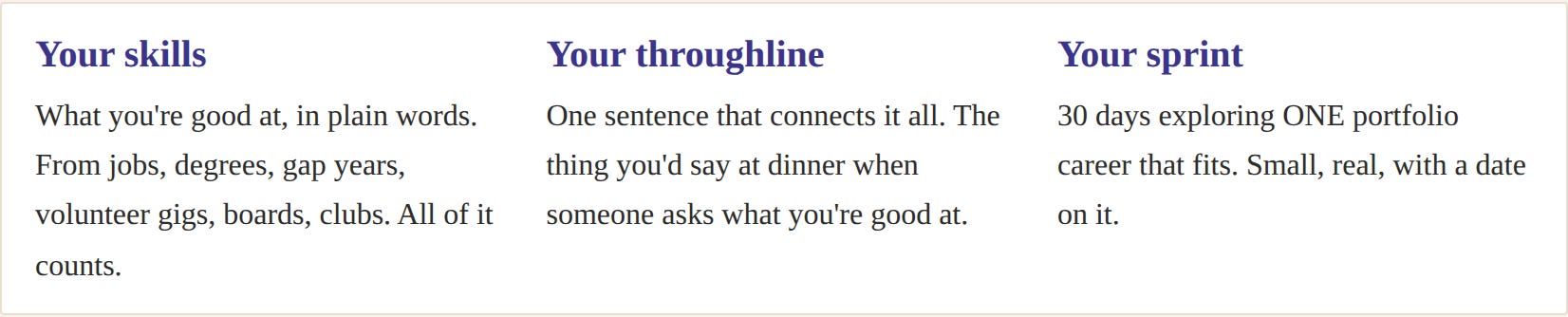
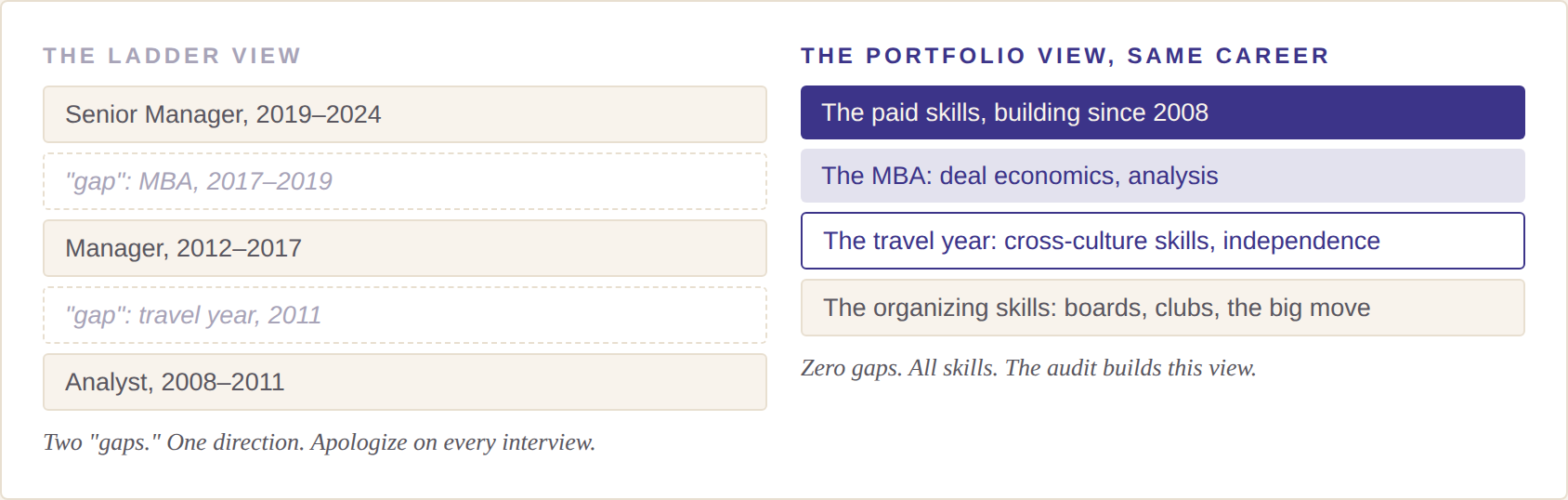
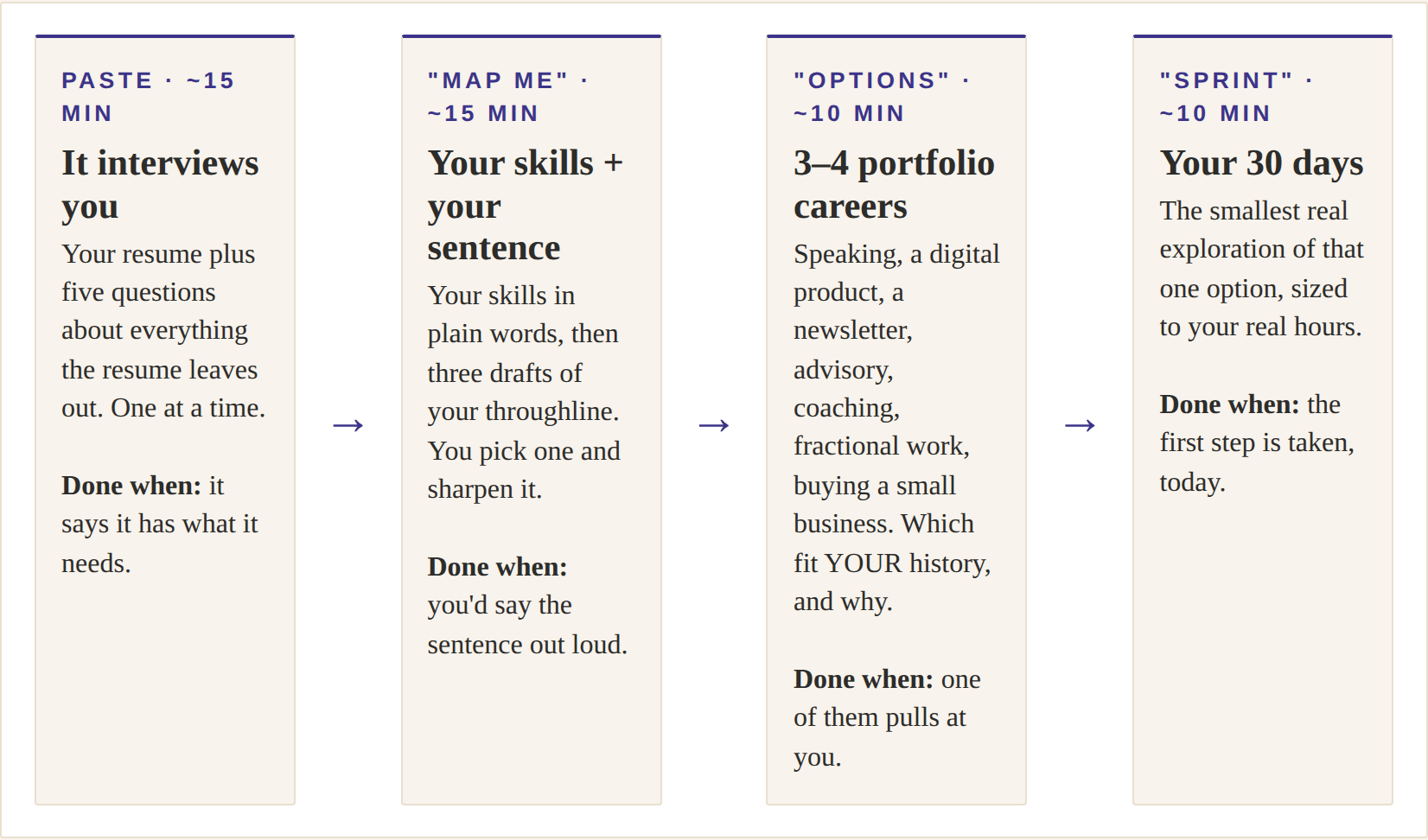
One paste. Three magic words. Under an hour.
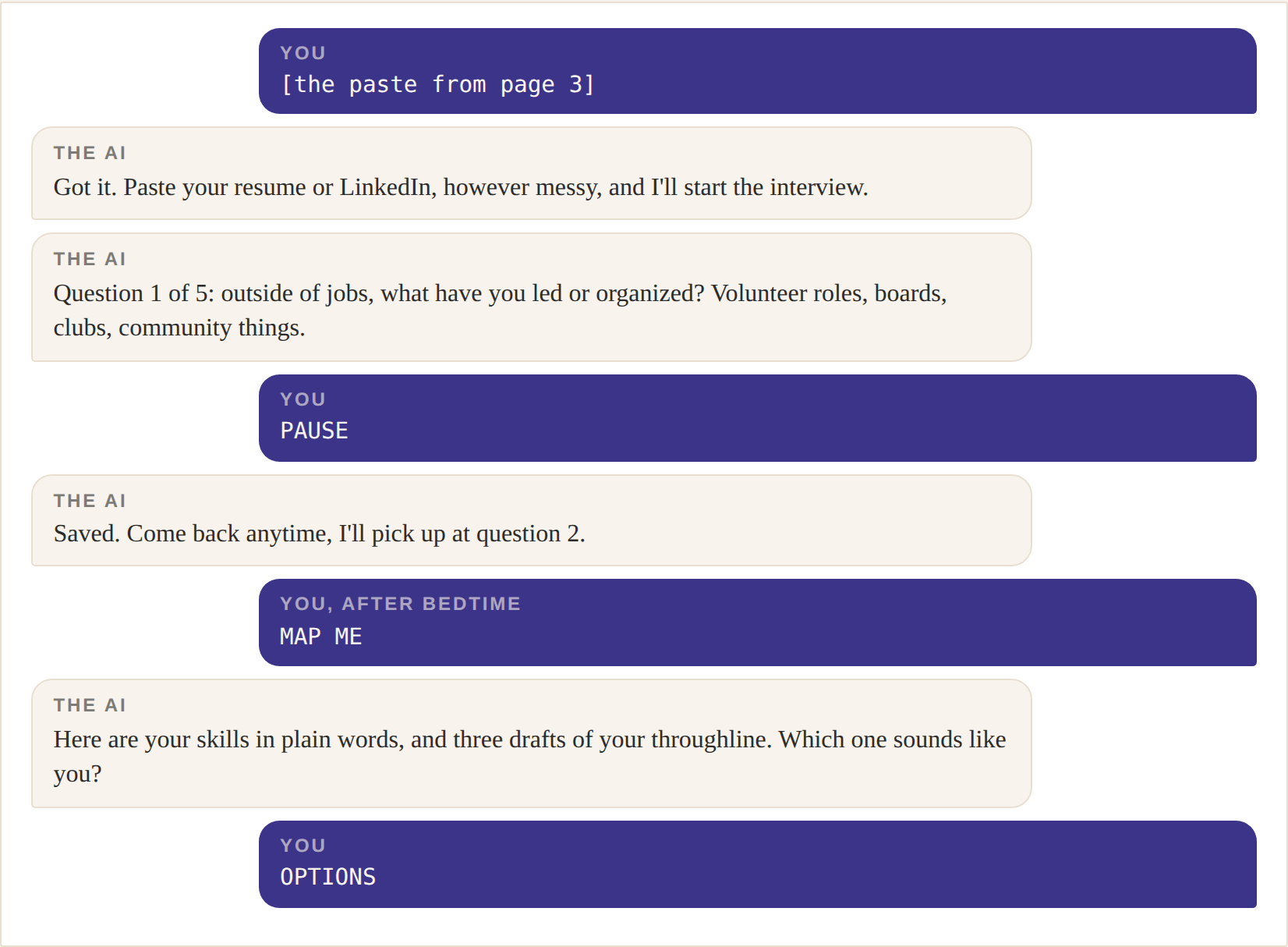
Open the AI that already knows you. Mine is Claude (obviously). Paste the block below. From there it runs the whole thing and you just answer questions. If a kid needs you mid-anything, type PAUSE and walk away. It saves your place and picks back up after bedtime. I built this around my life, not around an empty Saturday, because I don’t have one of those either.
Here’s what the hour looks like as a conversation:
This block is the entire setup.
Copy it in. That’s the setup, all of it:
You are running my Portfolio Career Audit. This is for me first, to see my own
throughline clearly before I ever say it out loud to anyone else. Rules:
- Interview me ONE question at a time and wait for my answer.
- Do NOT flatter me. Be specific and quote my actual history back to me.
- If I type PAUSE, summarize where we are so I can come back to this thread later.

STEP 1 - COLLECT. Ask me to paste my resume or LinkedIn, however messy. Then ask
me these five questions, one at a time:
1. Outside of jobs, what have I led or organized? Volunteer roles, boards, clubs,
   co-chair gigs, community or gym things.
2. My education and my gaps: degrees, an MBA, a gap year, time abroad, career
   breaks. For each one, what did it actually teach me? (Cross-culture skills and
   independence count as much as coursework.)
3. Every side project I ever started, including the dead ones.
4. What do people repeatedly ask me for help with?
5. What work makes time disappear for me, and what makes it crawl?

STEP 2 - When I say MAP ME:
(a) List my skills in plain language, pulled from my real history. Think like an
    operator: things like ops, strategy, cross-functional collaboration, systems
    design, deal economics, customer journey. Use MY versions, from MY history.
(b) Write THE THROUGHLINE: one sentence that says what I’m good at, that I could
    say out loud at a dinner. Not a title, not a brand statement. Give me 3 drafts
    and help me sharpen the one I pick.

STEP 3 - When I say OPTIONS: propose 3-4 portfolio careers that fit my skills and
history, drawn from paths like: paid speaking, a digital product, a newsletter,
advisory work, coaching, fractional work, investing in or buying a small business,
launching a business. For each one: why my history fits it (or where it doesn’t),
what starting small looks like, and a rough monthly number it could earn. Rank
them by which I could explore in 30 days.

STEP 4 - When I say SPRINT: ask for my real weekly hours, then design a 30-day
exploration of ONE option. Small real steps, at least one involving another
person, a number attached, and a finish line with a date. End with the one first
step to take today.

Begin with Step 1.
A few notes before you run it:
Question 1 is where the good stuff hides. The auction you co-chaired, the board seat, the team you manage at the gym. None of it is on the resume. All of it is skills.
Question 2 turns “gaps” into inventory. An MBA is deal economics. A travel year is cross-culture skills and independence. A career break is usually an operations job nobody named.
Short answers beat polished ones. It’s a dump. Typos welcome (I’d be a hypocrite otherwise).

What you get back: three things, on one page.
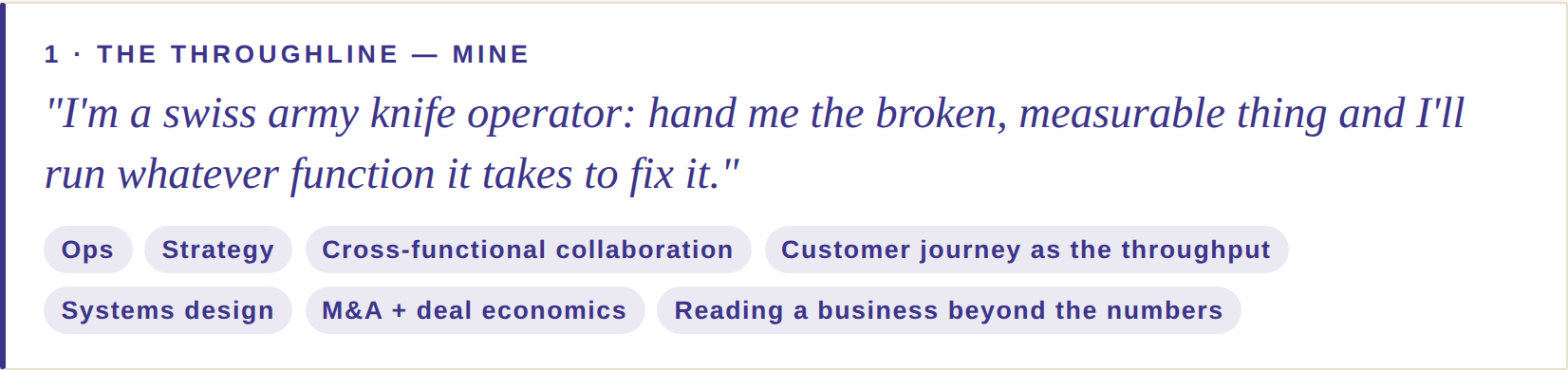
The sentence and skills below are mine, from running this on myself. Of the three drafts it gave me, here’s the one I kept:
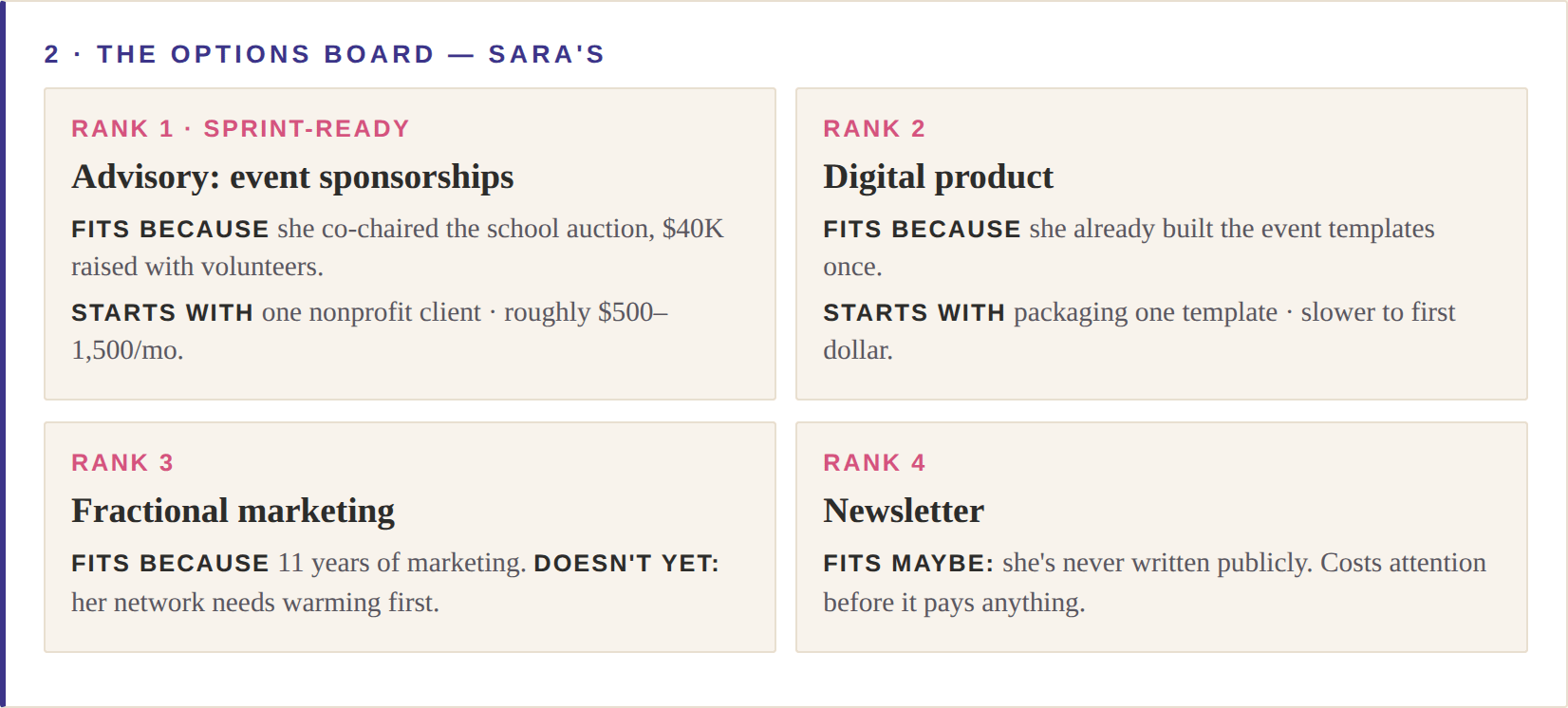
The options board is “Sara’s” (made up, but you know her): 11 years in marketing, then 4 years part-time.

30 days on one option. That’s the outcome.
I get my dopamine from action, and the sentence only becomes true once I act on it. The sprint is small on purpose: 30 days of small real steps beats a year of thinking about it.

Still employed and staying? You’re in the BEST position to run this. The paycheck funds the experiments. That’s the version of this I wish I’d run in tech. And if you have zero free hours, your sprint is one conversation. One person, one chat about one option. It fits outside school at pickup.

Park without guilt is a legitimate outcome, by the way. An option that fails a fair sprint just saved me a year of wondering. I parked buying an accounting firm. For now. That can change as I source more deals.
Sara runs the whole thing.
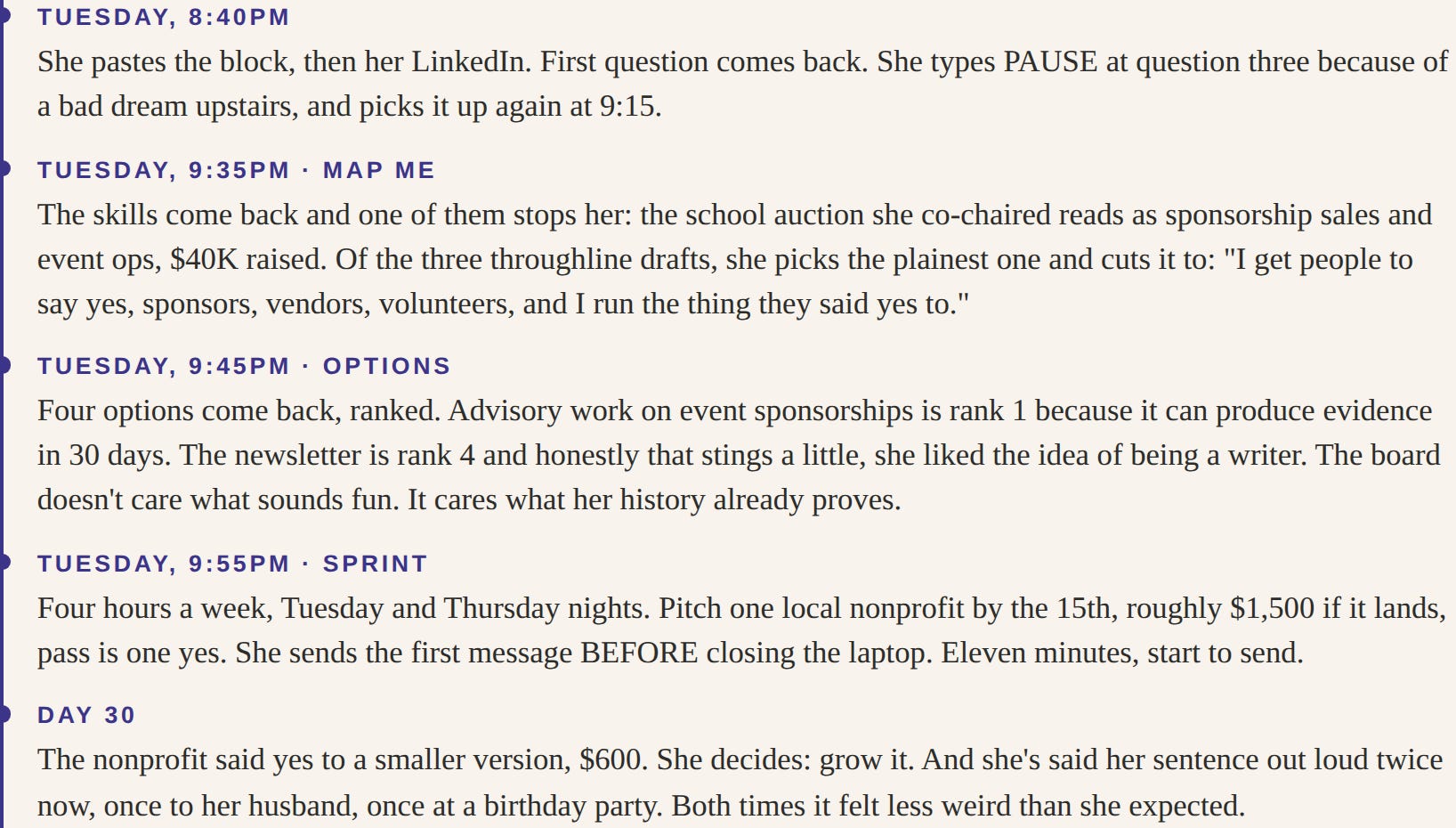
Notice what the sprint did. It wasn’t just the $600. She internalized her own sentence first, then said it out loud. That order matters. The audit is for you before it’s for anyone else.
Skip these four mistakes.
Accepting the compliments. If your skills list reads like a greeting card, it failed. Make it quote your actual history, the auction, the MBA, the gap year, or run it again.
Stopping at the sentence. The throughline feels so good to finally see that it’s tempting to stop there. The sentence is the map. The sprint is the trip.
Sprinting on the option you love instead of the one that’s ready. Rank 1 is rank 1 because it can produce evidence in 30 days. The one you love will still be there in month two.
Hiding behind it. I did this for most of last year: I had the throughline and wouldn’t promote it. Internalize it first, yes. But the sentence is meant to be said out loud, and there’s a date by which you should have said it to one real person.
Where to go from here
This week: the paste, your skills, your sentence. Under an hour, PAUSE allowed.
This month: the sprint, live, with a finish line on it.
Day 30: decide. Grow it, keep it small, or park it without guilt.
Save this. Share it with a parent who needs it.
I’ll see you after carpool.
— Danielle
Yes! I am in the middle of a re-focus of my publication from general homeschooling to the overlap of homeschooling and the portfolio parent. The first (stat heavy) post on this is 8/19.