
The Question My 6-Year-Old Asked That Stopped Me Cold
A drop in my stomach, a Gary Vee essay, and the ten-minute move I am running this week to stop living in the middle of mom life.

Last week I wrote that the skills rising fastest aren’t technical. This week I want to name what they actually are.
They’re analog.
My 6 year old came running off the soccer field on Saturday with a fistful of dandelions and one sunflower he had picked up somewhere on the way. We started walking toward the car. Then he stopped, looked up at me, and asked: can I just stay and pick more?
Of course, I told him. And then I felt this little drop in my stomach, because he had to ask. The most natural thing in the world for a 6 year old on a sunny Saturday next to a soccer field, picking flowers in a patch of grass, and he had to check first to see if it was allowed.
I looked up and saw the younger two also running around, picking up dandelions and blowing them in the wind. We stayed another twenty minutes, then walked over to the park I had promised them a few weeks back, when it was too cold and rainy to go.
The next day, the library. We walked out with twelve paperbacks between the three kids and a kids’ magazine my 6 year old picked for himself. The whole afternoon felt like 1994.
They didn’t need a lecture to do any of this. They needed an hour of unscheduled time and a parent who wasn’t on her phone.
Modeling presence, it turns out, is the part our kids actually absorb. Not the lecture about screens. The version of us they watch with our hands in dirt and a book in our lap.
I kept thinking about that all week. Then a Gary Vee essay landed in my feed and gave me a frame for what I was feeling.
The middle is dying
Gary Vaynerchuk published an essay in March called “The Retail Barbell Effect.” I came across it this week. One line in particular keeps coming back:
The middle is dying.
He’s writing about brands. He could have been writing about us. The whole pitch is that culture is splitting into two extremes. Extremely digital on one end. Extremely analog on the other. The middle is collapsing.
We have all been living in that middle. The middle of mom life is the phone in our hand at dinner. The middle is half-watching the kid show while half-answering Slack while half-thinking about whether we defrosted the chicken. The middle is the AI-generated email we did not really read. The middle is scrolling instead of resting.
The middle is the part that’s killing us.
Not AI. Not the phone. Not the TV. The middle.
The real talk: I keep seeing the same content on repeat
I’ll be honest. I came back to social media a few weeks ago to amplify what I am doing here, and I am floored by how much of it is the same thing on a loop. Everyone is copying everyone. The same trends, the same audio, the same setups. The “hallelujah something hallelujah” reel format is everywhere right now. I am one more scroll away from losing it.
I cannot tell what is original anymore. AI-generated content piles on top of the copying, dressed up so we can’t tell it apart.
That is when the gross feeling shows up. Not annoyed. Not skeptical. A knot in the stomach. The “oh, this is gross to look at” feeling that you cannot really shake.
The voice in the back of my head got loud. The one that says: I refuse to lose myself to this.
I refuse to be the version of me who scrolls through the family dinner.
I have a clear mental image of the parent I do not want to become. She is half-present at everything. She does not have time to walk over to the park. She is exhausted from a life she is technically running.
That is the identity pain in its 2026 shape. We are reading the room before everyone else does.
What I tried this weekend
So I leaned hard in both directions this weekend.
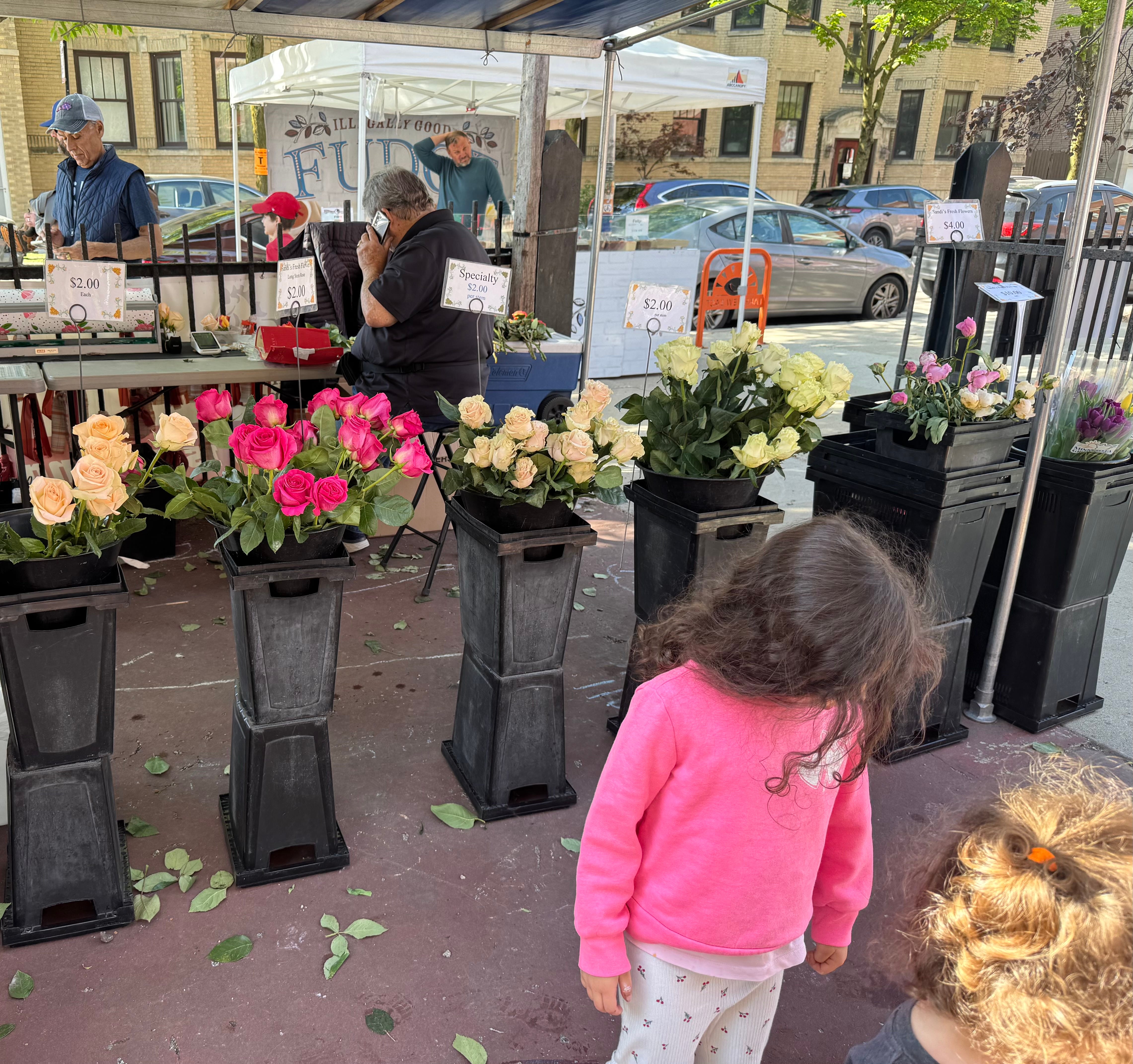
On the analog end, the moments stacked up. The farmers market on Sunday morning, where one of the kids taught the others a chasing game called “stranded boat.” A basil plant we brought home and put by the window so we can watch it find the sun, basil burrata pizza already on the menu one night next week. The Wall Street Journal on the kitchen counter, with my son climbing up next to me to look at the pictures in an article about watches. A rocket ship fort taking over the living room by the afternoon. My youngest at the park, eating a piece of dirt, spitting it out, looking at me, and trying it again. He’s the third kid. If you know, you know.
On the AI end: two new things.
The first one. I had messed up my son’s lunch order two weeks in a row through the school portal. So I screenshotted the prepaid order calendar, told Claude which days were orange (already ordered) and which were red (not), and asked it to drop a 5-minute reminder on my primary calendar at 7am for the days I had paid for. The whole setup took two minutes. Now I just glance at my phone, see the reminder, and know. I will never miss another lunch order.
The second one is the habit I am picking up right now, and here is the moment that made me start. I almost double-booked our Sunday morning next week. I had made brunch plans a month ago with a friend who is hard to find time with, and meanwhile my husband had been trying to coordinate something with friends of his for the same Sunday morning. Neither of us had put any of it on the shared calendar. I caught it by accident. That was when I realized: if we don’t make this easier, we are either going to stop committing to weekend plans at all, or we are going to overcommit and let people down. Neither is what I want.
So I stopped going into Google Calendar to add things. I open Claude on my phone and talk into it. “Book brunch in the morning next Sunday.” “Friends over in the afternoon, same Sunday.” Done. The friction of opening the app, picking a date, typing it in, sharing it, that friction was what was quietly stopping me from booking the analog hours in the first place. Killing the friction is what is freeing up the weekend.
Both of those AI moves bought me back time I am now spending on the analog end. That is the barbell, working in real time.
The Amazon Prime move is coming for everything
Ten years ago, none of us decided that two-day shipping should become our default. Amazon Prime just absorbed the question of where we order from. Nobody picked. The category became Prime, quietly, on every order.
Agents are about to do the same thing, except now the categories are bigger. Which take-out we order on a Wednesday. Amazon ordering toilet paper before we even know we are out, the whole household-supply category quietly running on autopilot. Which sport we sign our kid up for next year, if we don’t keep that one for ourselves. Remember the mom from a few editions back running eleven agents? She is already there, with Amazon running the orders before she even thinks about them. This is not five years away. It is now.
Gary Vee said it plainly on a podcast in March:
“I said, Alexa, order me a pizza. If you don’t say Domino’s, you’re dead. Agents will order for you if you don’t care.”
The agent picks a default if we don’t pick first. That is the whole game. And by the time we notice, the category will be theirs.
The barbell is how we get ahead of it. Hand over the routine middle on purpose. Protect the analog edges on purpose. Either we choose, or the agent chooses for us.
The B+ mom on the front page
The analog turn is showing up in places I did not expect. There was a piece in the Wall Street Journal this weekend about a mom with three kids, ages 15, 13, and 7, who is essentially a B+ mom. She is very type A at work. At home she lets her two older kids do whatever they want across LA, as long as they are home by curfew. She doesn’t pack the weekends with concerts and coding camps and resume-building competitions. She leaves dishes in the sink sometimes. Letting go was the harder thing for her, and she did it on purpose.
The piece pointed at something a lot of us have been quietly noticing for a year now. The kids who got the most planned, the most coded, the most polished resumes? Those kids are not necessarily landing the jobs the planning was supposed to lead to. The promise we were sold (over-schedule the childhood, win the future) is just not panning out.
The analog version of childhood is not a downgrade. It might actually be the upgrade. Dirt. Boredom. Picking dandelions next to a soccer field. Walking the library with no plan. Watching mom read an actual newspaper. Building a rocket ship fort in the living room.
These are starting to look less like nostalgia and more like the strategy.
Here is how I am running it this week.
Try this before Friday
I am picking my two edges this week. I am sharing mine, and giving you three to pick from on each end. The whole exercise takes ten minutes.
Pick ONE for the AI end (the middle gets smaller)
Fully delegate. Not “help me with.” Hand the whole thing over.
1. The voice-to-Claude calendar habit. Tell Claude to schedule the time blocks and events you want this week and next weekend. Skip Google Calendar entirely. One important note: only give it access to your calendar, not your email. Calendar access alone is enough to make this habit work, and I have real concerns about handing AI broader inbox access right now. This is the habit I am picking up right now. The friction of opening the calendar app was what was quietly stopping me from blocking the analog hours in the first place.
2. The summer camp packing list. Open Claude (free) or any AI tool you already have. Paste this:
“Help me build a summer camp packing list. Camp name: [insert]. Kid’s age: [insert]. Length of session: [insert]. Quirks I want you to plan for: [list anything specific, like favorite sunscreen, favorite water bottle, whether they have their own sleeping bag or need to borrow one, favorite pillow]. Give me a labeled checklist organized by category.”
Add this one if camp packing in late May is giving you anxiety.
3. The weeknight dinner rotation. Open Claude, upload a photo of your freezer and pantry, then paste this:
“Here is a photo of what we have in our freezer and pantry. Give me five family-friendly weeknight dinners using only these ingredients. Two should have a step my kid can help with. None should take more than 30 minutes.”
If you know, you know.
Pick ONE for the analog end (the edge we protect)
On the family calendar. With a start and end time. Before bed.
1. Saturday 9-11am at home, no devices, all of us. Books, breakfast, building, dirt if the weather lets you. Phones in the box. Yours included. This is mine this week. We bought a little box for the counter, that is the rule.
2. Weeknight dinner, 6-7pm, phones in the box on the counter. The box is the rule. The least disruptive of the three. A smaller starting point if Saturday morning feels like too much.
3. Sunday afternoon at the library or a park. Bring a paperback. Leave your phone in your pocket or your bag. Watch the kids watch you. The modeling-presence move.
That’s the whole exercise. Two picks. Ten minutes. Don’t overthink it.
You’re not behind. You’re normal.
If we have been feeling this pull all spring, toward more in-real-life, toward putting the phone down, toward the library and the dirt and the dandelions, here is what I want us to hear.
We are reading the room. The two ends are exactly where culture is going, and we are getting there a beat early.
The middle is the part that’s killing us. We don’t have to fix the middle. We just have to stop spending time in it.
I am picking my two edges this week. Saturday morning at home, devices in the box. The voice-to-Claude calendar habit, locked in.
The dinner-table question we are asking tonight: “What would you do all day if we had no TV or tablets in our house?” Listen and take note of what they say. This will give you ideas of what the analog hour can look like next week.
If any of this got you thinking, hit reply and tell me what your two edges are. Or share this with a friend or someone who shares a home with you. The barbell lands better when more than one of us in the house is in on it.
I’ll see you after carpool.
Danielle
yes, Yes, YES!