
Someone said it to me three times this weekend
"This is so not you." Actually, it is. Just not the 22-year-old version.

They weren't wrong.
I came back to Montreal for a family wedding this weekend. It had been a while, and people were curious about what I’ve been up to. The newsletter, the AI consulting business, the acquisition work, the podcast appearances. Some people lit up. Some were genuinely confused. And a few said some version of the same thing: “this is so not you.”
And they’re right. The version of me they knew at 22 wouldn’t have done any of this. She was serious. She wore fancy work clothes and tried to look like she knew what she was doing. She followed the ladder because the ladder made sense, and it was the only roadmap she knew.
I used the time waiting at my gate to write in my journal. The ladder was a legitimate path for so long. It got me somewhere real. It just isn’t the best way anymore.

What I was actually building this whole time.
Let me tell you what was actually on my resume beyond the resume.
Auditor (ew). M&A consultant. Top 5 MBA grad. Tech VP.
That’s the title track. But the actual work was something different. Learning how to become the go-to person for international clients because I had built the exposure and the interpersonal range to handle it. Navigating boardrooms in cities where I didn’t always speak the language. Being one of the only women in a room of bankers and consultants for years on end and figuring out how to own the space anyway. Moving between Toronto and Montreal and overseas, multiple times. Having deals fall apart at the worst possible moment and learning how to read a room when everything had just gone sideways.
Every bit of that came with me. And it isn’t obvious from the titles.
Someone I know well got an offer at big law in New York. He speaks four languages and also has a degree from the Kennedy school (Harvard). You can say it started with a great undergrad and great early opportunities, but from my perspective he’s been stacking a kind of compounding judgment that will make him exceptional at everything that comes next.
What I mean by this is your skills outlast your tasks. It’s up to you to understand what you’ve actually built with them.
This is why its so important right now to understand how those skills compound.
Am I (and it) really that different?
Over the wedding weekend, I learned from a good few people that they were genuinely scared about AI and what it means for their jobs. And I kept thinking: is it really that different than technology shifts before?
Think about what has happened across the last 100 years. Physical labor became cognitive work. Cognitive work became knowledge work. Now knowledge work is becoming something that requires directing and interpreting AI rather than executing the task itself. Each time, the people who adapted were the ones who could articulate what they actually brought to the table beyond whatever the current tool was.
When I was an M&A analyst, I thought the job was building financial models. What I actually got good at was going from 30,000 feet to understand a whole business and then back into the details to catch the risk that wasn’t obvious, the thing that could change the deal price or be the reason you tell a client to walk away. Building the model was the task on the job description, but the judgment was the skill that I carry to this day.
I remember being one of 7 people in a room talking about entrepreneurship through acquisition during my MBA. I was the only woman. Again. Those sessions now draw 65 or more people, and the room looks completely different. That shift is happening because more people started asking what else might be possible for them. That curiosity was always there. Now there are tools to actually do something about it (like the magic of Substack with Claude Cowork for this newsletter).
The people I’m watching thrive right now are the ones who figured out what they actually built, pointed it somewhere new, and started moving.
(There is a real risk we atrophy when we outsource too much of our thinking to AI. I touched on this last week re our kids, but it applies to us too. That conversation is critical enough to deserve its own newsletter soon.)
I know this is true because I’m living it.
I’m not the same person I was.
Here’s what I really want to unpack, because I think it’s very relevant to the shifts we’re going to be seeing over the next 2 to 3 years.
I started posting on social media and writing publicly. Which sounds small. But building in public changed who shows up in my life. I’m having conversations with people I haven’t spoken to in years. I’m going on podcasts. I’m getting featured in other newsletters. I’m getting experiences I wouldn’t have gotten if I had stayed on the typical path, which for me was: do good work, hope it gets noticed, climb the “title” ladder and leave it at that.
What I didn’t expect: posting things out loud brings people back into your world.
At 22, I was serious, more cynical (still am?), very focused on external markers. Good grades. Good company. Good title.
What I notice now is how much of that has flipped.
I want less external validation and a lot more internal. Not “did I get the promotion” but “is this mine, does this feel like the version of myself I want to be in two years?” And I’m not alone in this. I’m seeing more and more people in my circle getting genuinely curious. They are semi-panicking about AI but at the same time curious about what they can actually build and do with it.
I am not the same person I was when I left Montreal 15 years ago. I’m good with that.
So here’s the toolkit.
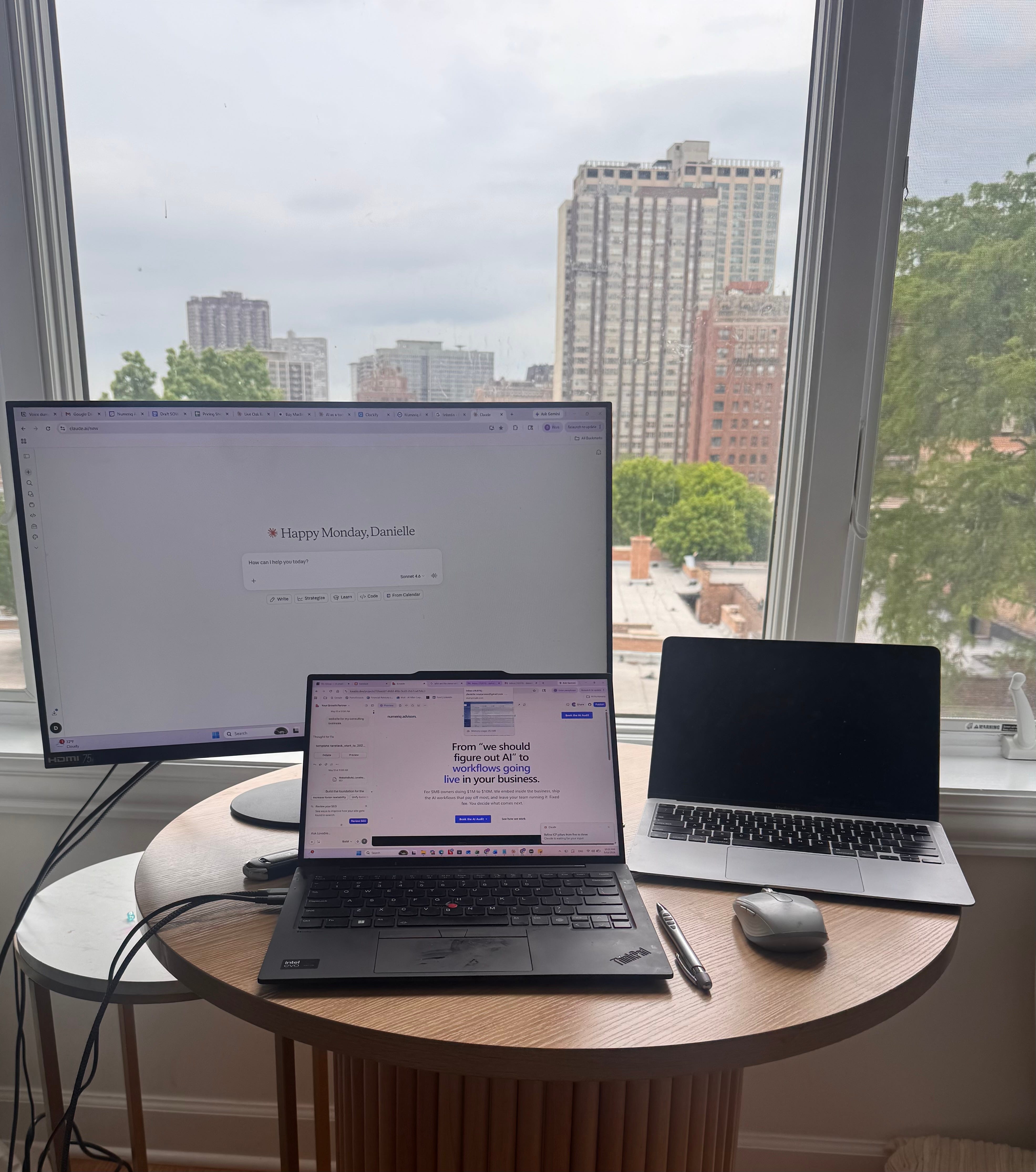
(FYI image above is me learning how to build a website with Claude Cowork + Lovable).
Here’s where I’d actually start.
Two steps and one prompt.
Step 1: Run this prompt. Paste it into Claude or ChatGPT. The AI will ask you two questions — one about your professional work, one about what you do at home or on your own time. Answer by voice note or just type it out. You’ll get back a clear picture of the skills you’ve built that you’ve probably never noticed or were able to name.
Here’s the prompt:
“I want to understand what skills I’ve actually built across my life. Ask me one question about my professional work and one question about what I do outside of work — at home, in my free time, or as a volunteer. Based on my answers, give me a picture of the underlying skills I’ve developed and how they could translate into a new career direction, a passion project, or something I could start to monetize. Be specific. Don’t give me generic advice.”
From what comes back, find the one thing that makes you feel something. The one where you think: “actually, yes.”
Step 2 (Level Up): Build a Claude Project around it. A Claude Project is a dedicated workspace inside Claude that holds your files, notes, and context, and remembers it all every time you come back. A regular chat forgets the moment you close the window. A Project builds over time.
Start by pasting your skills analysis in as the foundation. Then add things as they come up: notes you kept on your phone, job descriptions that catch your eye, ideas from conversations. Claude connects the dots. It becomes a working system for figuring out where you’re going, not just a one-time conversation about it.
I’ll do a full walkthrough on how to set this up. If you want to get started before that, reach out to me directly.
And if you’re someone who feels like you’ve been on the sidelines of all of this, this last part is especially for you.
For anyone who felt like they had to sit out.
There are a lot of parents, and a lot of moms especially, who paused or shifted careers in ways that don’t map neatly onto a resume. The skills built during that time, managing complex logistics, negotiating with irrational humans, keeping a whole household running, never showed up in a title.
For a long time there wasn’t a clear way to translate any of that into what the world was calling career growth. Now there is a whole toolkit that can help you do the translation. You don’t have to be technical. You don’t have to have kept up. You just have to be honest about what skills you’ve built, and be willing to start.
The career path doesn’t have to be vertical to matter.
You have more than you think. Start there.
This week’s dinner-table question: “If you had to describe what you’re actually good at to someone who had never heard your job title, what would you say?”
I’ll see you after carpool.
Danielle