
Should I Actually Be Worried About This?
What a computer science degree, a selfie filter, and a CEO who wants his kid playing in the dirt taught me about what our kids actually need.

Last week I promised you I’d dig into the question I can’t stop asking myself. And I’ve been sitting with it all week. The answer is yes, I think we should be paying attention. But it’s not the kind of scared you might expect.
I’m not worried about some sci-fi future where robots take over. I’m worried because the path we were all told to follow, do well in school, get good grades, land a stable job where you’re rewarded for being smart and reliable, that path is quietly becoming outdated. And most of us haven’t caught up to that yet. Not for ourselves, and definitely not for our kids.
The Safe Path Isn’t as Safe Anymore
Someone close to me has a sister who just finished her computer science degree. Four years of school, exactly the kind of degree everyone says you should get. She can’t find a job. Not because she’s not smart or didn’t work hard, but because AI tools can now do a huge chunk of what entry-level developers used to get hired for. The ground moved while she was still in school.
That’s the part that really got me. It’s not that computer science is useless. It’s that the thing we all thought was the safest bet turned out to be one of the first things to change. And if that can happen to computer science, what else is going to look different by the time our kids are entering the workforce?
Anthropic (the company behind Claude) just published research on how AI is actually showing up across different jobs. They mapped it out and it looks like a web, touching everything from programming to customer service to data entry. Computer programming tasks? AI is already handling 75% of them. And here’s the part that stuck with me: they found that hiring of younger workers is starting to slow down in the jobs most exposed to AI. That’s our kids’ future we’re looking at.
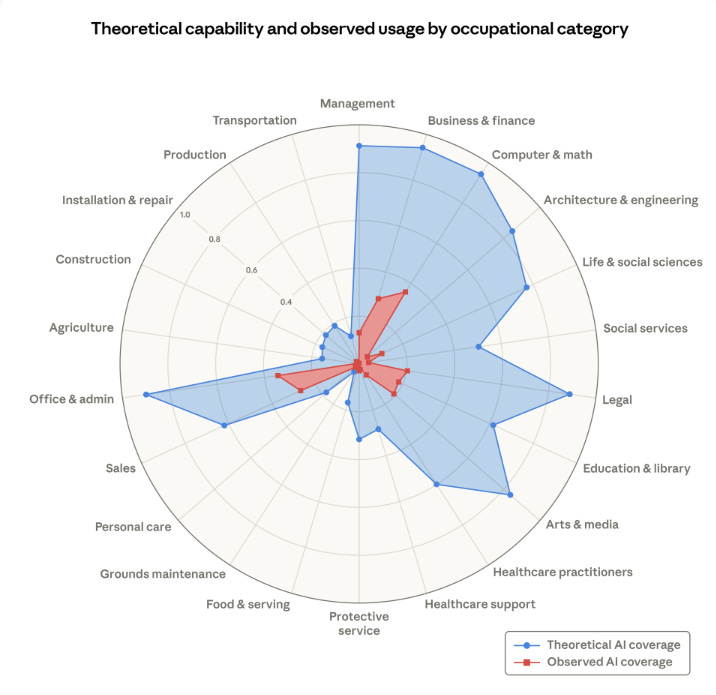
When you zoom out, it’s not one industry or one job that’s being affected. It’s everything that involves doing smart but repetitive tasks. The kind of work a lot of us were trained for. The stuff that used to be rewarded with stability and a good paycheck.
What’s going to be rewarded instead? Creativity. Breaking down messy problems that don’t have a clear answer. Being willing to try something, fail, and try again. Less “follow the playbook” and more “figure it out as you go.” That’s a huge change from how most of us were taught to succeed.
So What Are We Actually Teaching Our Kids?
If the skills that matter are changing this fast, you’d think school would be keeping up. I’m not so sure.
My son had a “technology class” recently. You know what they did? Tested out different filters. Like selfie filters. That was the lesson. Not how technology works, not how to think through a problem, not how to build something. Just playing around with different filters. I sat there thinking, they’d honestly be better off playing outside right now. At least then they’d be problem solving on the playground.
And that’s kind of the bigger question, right? Schools went all in on Chromebooks and screens over the last few years because it felt like progress. Everything digital, everything online. Now there’s a growing wave of parents and teachers pushing back and saying, wait, maybe handing every kid a screen all day wasn’t actually what they needed. Maybe what felt advanced was the opposite of what would actually help them learn.
Sam Altman, the CEO of OpenAI, the guy who literally built ChatGPT, said something in an interview that I keep coming back to. He said he knows his kid is going to grow up in a world where computers are smarter than people. He sees it coming more clearly than anyone. And he still wants his kid on the later end of interacting with AI. He wants him to just play in the dirt right now. The person who arguably knows more about this technology than anyone on the planet is choosing play over screens for his own child. That tells you something about what actually builds the foundation kids are going to need.
And then on the complete other end, there’s a school opening in Chicago called Alpha School where AI handles the teaching. Personalized to each student, about two hours in the morning. The rest of the day is projects, building things, entrepreneurship. It’s coming to the old Gems Academy location, right where I used to work, and before that close to where I lived in business school. So this one feels personal.
The model is intense and definitely not for everyone, but the core idea, that each kid gets exactly what they need instead of one lesson for 25 kids, that part makes a lot of sense. The question is what our regular schools can take from that approach without throwing out everything that makes school valuable, like learning how to be around other humans all day.
Somewhere between selfie filters and an AI-powered curriculum, there’s the thing our kids actually need. And I don’t think most schools have found it yet.
The Part That Surprised Me
Here’s the thing I wasn’t expecting. This isn’t just about our kids. It’s changing things for us too, right now.
I keep hearing stories from friends where their kids are the ones helping THEM with technology now. People who were always good with tech, always the ones who figured things out, and suddenly the roles flipped. It happened that fast.
But I’ve actually been experiencing the opposite, and it’s been kind of wild. I’ve spent my whole career in finance and operations. Numbers, models, strategy. I never once thought of myself as a creative person or a builder.
Since I started really using AI in my work, I’ve been building things I genuinely didn’t think I was capable of. The full brand for this newsletter? I built that. Financial models I would have needed a team for? I’m doing those on my own. I heard Sinead Bovell talk about this and it clicked for me. She described it as this moment where you realize, wait, I’m not just the analyst or the operator. I’m actually a creator. I can build things. What else can I become?
That question is the one that keeps me up at night, but in a good way. AI isn’t just changing what jobs look like. It’s changing what WE can look like. The titles, the lanes we stayed in, the way we always described ourselves, those walls are coming down. And that’s actually exciting.
So What Do We Do With This?
I think the most important thing right now is to start noticing. Knowing something conceptually (“AI is going to change work”) isn’t the same as actually seeing how it shows up in your life and your kids’ lives.
For your kids: Pay attention to what they’re actually learning in school versus what they’re going to need. Are they being taught to follow instructions and get the right answer, or are they being pushed to figure things out, get creative, and be okay with getting it wrong? The second one is what’s going to matter.
For you: Try building something with AI this week. It doesn’t have to be impressive. Use ChatGPT or Claude to make something you didn’t think you could make. A meal plan, a project outline, a design for something in your house. See what happens when you bring the idea and let the tool handle the execution. You might surprise yourself.
The world is changing fast and yes, that can feel scary. But the opportunity is massive, for our kids AND for us. We just have to be paying attention and willing to learn alongside them.
What’s Coming Next Week
This week was about jobs, school, and what we’re building toward. Next week it gets personal. AI is showing up in places that are going to make you uncomfortable. Kids choosing to hang out with an AI companion instead of playing with friends. Songs being generated by AI that sound exactly like your favorite artist but aren’t. One in four millennials saying they could see AI as a romantic partner. Meta talking about a future where the content on your Instagram feed is generated just for you, by AI, and nobody else ever sees it.
It’s getting weird. And we need to talk about it.
I’ll see you after carpool.
Danielle