
I was so sure I had it figured out
Then I found out I'd ordered my son a cookie for lunch. Here's what AI can't do for our families.

Everyone keeps asking what AI is going to take from our kids. I keep asking the opposite. What if, used on purpose, it gives us back some of the things we actually miss?
I was so sure I had it figured out.
Let me tell you about the Monday I found out I’d ordered my son a cookie for lunch. Just a cookie.
A little backstory. I had forgotten to order his lunch twice, back to back, two weeks in a row. If you’ve ever gotten the text from the teacher that your kid has no lunch, you know the exact feeling. It wrecks your whole morning.
So I built a fix, and I was proud of it. I took a picture of his lunch calendar and handed it to Claude in Cowork. The deal was simple. On the orange days, the ones I’d already ordered, drop a 7am reminder in my email that says “lunch is ordered,” so I don’t pack one for nothing. The other days get no reminder, because those are the ones I still prep myself. The schedule moves around, Mondays and Thursdays one week, Tuesday and Friday the next, and the thing that used to make me crazy was lying in bed at night, not remembering if I’d ordered, dragging myself back to the app to check.
It worked. The reminder came through. I felt so smart. One more nagging little thing, handled.
And then, a couple of Mondays ago, I got a gut feeling. Wait. Did I actually do that right? My Claude reminder had already told me lunch was ordered. I logged into the app anyway. And there it was. I’d ordered him a cookie. Only the cookie.
I caught it myself, texted his teacher, panicked, grabbed his favorite pizza and drove it over. At the end of the day she told me he’d still been upset. I lost an hour of work. And a little bit of my son’s trust. I had been so sure I had it all figured out with AI.
AI did exactly what I asked it to. The catch is, it can’t care whether I got it right. That part is still on me.
Which is really what I want to talk about today.
So I went and asked someone who actually knows.
Here’s where I’ll be honest with you. I use AI all day, for my work, my business, this newsletter. And I still felt unsure about where it belongs in my family. That is an uncomfortable place to sit.
It’s also, apparently, a very common one. A lot of women are quietly sitting this out, and the research backs it up. We’re about 22% less likely to use AI than men. I feel that hesitation in my own chest. But I don’t want to be on the wrong side of it, and I really don’t want my kids to be.
So I sat down with Sarah Dooley, the woman behind AI Empowered Mom. She spent years building AI inside big companies, and now she helps families figure out how to actually use it. Her book, AI Empowered Family, is on the way. I came in with my cookie story and a hundred questions, and she handed me the one idea that reorganized everything. (FYI she also has an awesome newsletter that I highly recommend!)
Her insight: don’t start with the tool. Start with your values.
She and her husband wrote a short family mission and named a few core values before they ever made a single rule about technology. Once those are on paper, the AI decisions stop being agonizing. If your family value is a joyful celebration, then using AI to help plan the party isn’t cheating. It’s serving the thing you already care about.
Once you get clear on what you actually value, the day-to-day AI decisions kind of make themselves.
So I tried it. Here’s what came up for us.
So I grabbed a notebook and wrote it down.
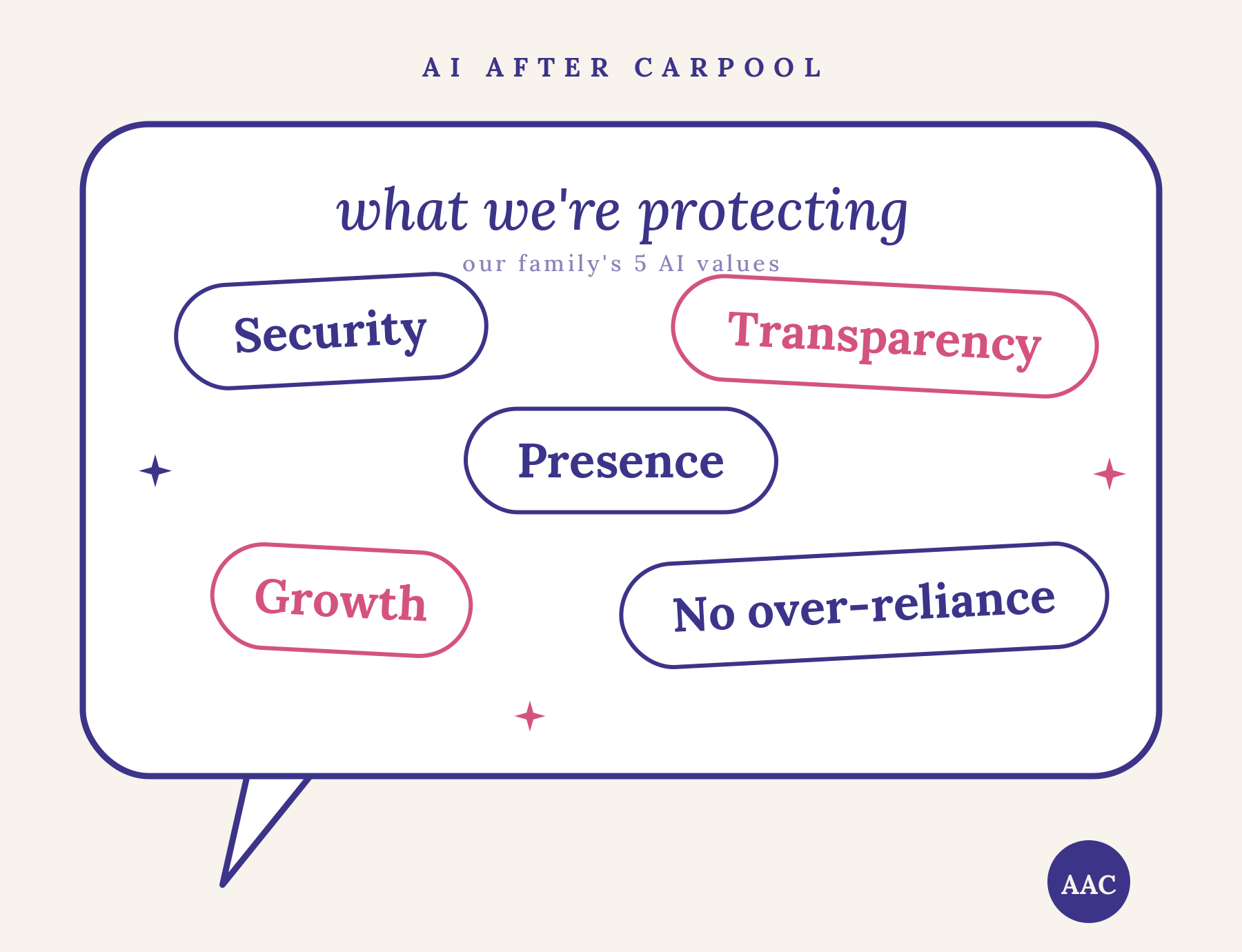
I sat with one question: what are we really protecting in this house? The same few things kept surfacing.
Security. My kids’ faces and names don’t go into AI, and they’re not on social media. That isn’t mine to hand over.
No over-reliance. The minute a tool turns into a crutch, it’s working against us.
Transparency. My kids see how and when I use it, out loud, never behind a screen.
Growth. If it’s making us sharper, great. If it’s making us lazy, that’s my cue to pull back.
Presence. This is the big one. I’ll happily use AI to amplify the real, in-person, slightly messy parts of our life. I won’t let it quietly become one more thing we lean on too hard.
Write those down and you get a single test that does most of the parenting for you.
Does this use of AI amplify presence, or replace it? If it amplifies, I’m in. If it replaces, it’s a no.
That test gets a lot clearer when you think about the kids specifically.
When do we hand them the keys?
The honest answer is that I’m still figuring this out, and anyone who tells you they have it perfectly mapped is selling something.
But there’s one idea I keep coming back to. Sarah pointed me to a framework her friend Julie Kelleher created and trademarked, called Parent in the Loop. The analogy Julie uses is teaching a kid to ride a bike. First your hands are on the handlebars. Then a hand on the seat. Then you’re running alongside, lungs burning. Then, only when it’s safe, you let go. AI is the same. With my littles, my hands are still firmly on the handlebars, and I am in no rush.
A couple of hard lines I’ve drawn in the sand. Companions are the first one. The thought of my kid pouring their heart out to an AI friend genuinely scares me, so that’s off the table until they’re much older, sixteen, maybe eighteen. I think about it exactly the way I think about social media age limits. Same logic. Same reasons.
The skills that make someone good with AI come first, long before the tool shows up. Critical thinking. Judgment. You only build those by doing things the slow, real way.
Something a friend told me has stuck with me. Her daughter, about ten, and her friends had to write a goodbye message to someone who mattered. The first instinct, instantly, was “let’s ask ChatGPT.” And I get it, I do. But that is not how a child learns to say goodbye. We want them to fumble for their own words first, to feel the lump in their throat, so that years from now, when they do have these tools, the muscle is already there. Kids reach for AI for the same reason we do. To take the friction out. But with some things, the friction is the entire point.
We do the real thing first, so the muscle is built before the tool ever shows up. AI can help them polish it later. After the thinking, never instead of it.
And once you see it that way, there’s one use of AI I’ve completely fallen for.
My favorite way to use AI all summer.
This is where the tool and the childhood I actually want for my kids finally meet.
Point the AI at the offline adventure. Then close the laptop and go live it.
Ask it for twenty ideas for a boredom jar. Have it design a backyard scavenger hunt, plan the campout, draw a pirate treasure map. Two minutes of prompting, and then it’s chalk and dirt and melting popsicles from there. The AI did the prep. We do the living.
And this is the gentlest possible way to bring a kid to the handlebars. You’re driving, they’re watching over your shoulder, and the whole payoff is something they make with their hands, off the screen completely. AI as the setup for presence. Never the substitute for it.
So here’s where I’d start this week.
Try this: the old-school list.
My actual summer list. Not a Pinterest board. The real, slightly dorky, sit-on-the-floor stuff I keep getting nostalgic for.
The old-school click camera. The film one I brought to camp and took on a trip. No screen to check. You just wait for the photos.
A Walkman. Yes, really.
Pick-up sticks. In my Amazon cart right now, pure nostalgia for the games we used to play.
Bike rides by the water. Even after camp and school. The weather is finally right for it.
Ice cream at the end of the day. Even when it’s already evening. Especially then.
Hopscotch. Chalk, a sidewalk, done.
A pogo stick. I got my daughter one, and it has been a hit.
The beach, once a month. No excuses. That one is mine.
Mini golf by the lake. The one my kids love.
Pizza down the street. Pick it up, walk it home, eat it together.
✦ THIS WEEK: THREE SMALL MOVES
1. Pick three from your own version of that list, the ones that would actually define your summer. Mine starts with the beach, once a month.
2. Write one family AI rule together, even with little kids. Ours is heading toward: “AI helps us make things and learn things, with a grown-up. It is never our friend, and never our secret.” A rule they help write is a rule they keep.
3. Use AI for just one of those three, to plan it, with your kid right there beside you. Let them watch you drive.
What I’m really after, under all of this, is simple. To stay close to the people in my house while the world speeds up around us.
So forget the perfect system. I clearly don’t have one. Get clear on what you’re protecting, and protect it on purpose.
Here’s what the cookie taught me. The lunches I botch fade fast. What sticks for my son is that I showed up, flustered, holding his favorite pizza, paying attention. Right there beside him, hands on the handlebars.
So go buy the pick-up sticks. Get the evening ice cream. Be gloriously, deliberately present. You’re more ready for this than you think.
This week’s dinner-table question: “What’s one thing only a human can do that a robot never could?” Ask the kids. Then sit back and listen, because their answers are almost always better than ours.
I’ll see you after carpool.
Danielle
I think you touched on exactly what makes the mental load so stressful -- finding ways to delegate it without dropping (critical) balls. I'm always saying: if your delegation hits a snag (like this) it doesn't mean it failed -- it means you have the right information to tweak the system.
Did you find out what led to your ordering just a cookie --- the "root cause analysis" -- and solve for that?
And I totally agree that using AI to create space for analog presence is the big win. We talked about that in our chat too! https://thethirdshift.substack.com/p/can-ai-lighten-the-mental-load-a
Thanks so much for the shout-out, Danielle! I loved our chat and can't wait to continue the conversation.