
I almost bought the wrong business
The smartest tool I own cheered me on the whole way.

I almost bought an accounting firm.
And I don’t mean I was daydreaming about it. I was deep in the broker sites, talking to firm owners, meeting with brokers. The whole time I had ChatGPT (because I wasn’t into Claude YET) telling me it was a great fit for me, and it was really wrong.
Some of you already know where this is going.
It’s 10pm, everyone’s finally asleep, and you’ve got the tab open again. You asked it to build you a plan and it built you a really good one. It told you the idea was strong. And somehow you’re sitting in the exact same spot you were sitting in back in January. The plan could be a new job, career pivot, writing a newsletter. You name it.

(This is what "keeping my options open" actually looked like, nothing enters the “done” box).
Last week I gave you six moves and told you to start, and I meant it. But starting was is only part of it, so I owe you the other half of that conversation.
Here’s what this edition is. By the end of it you’ll know the specific way AI can walk you confidently in the wrong direction, why the people who are BEST at learning are the most at risk (which was very fun to find out about myself), and the 3 things I do now so that I actually finish something.
Save this one, especially if you’ve been “looking into” something for a while.
How the analysis walked me into the wrong industry
When I started looking at businesses to buy I had some context, but not much beyond what was traditionally considered a good fit. Recurring revenue, fragmented, non-discretionary, limited customer concentration. The boring stuff. But I wasn’t exactly sure which industries were the right fit. So I did what I always do when I don’t know something. I went and learned.
I spent a good few months on the broker sites. (Which IS the right place to look, by the way. That part wasn’t the mistake.)
And somewhere in there, the analysis walked me straight into accounting firms (plus one or two Acquiring Minds podcasts, IYKYK).
Every reason checked out. I understood the industry, it was completely remote (great when you have three little kids like me), it was professional services which I know cold, and I really liked the people I’d be working with. I talked to brokers, I looked at real firms, and every time I brought the thesis back to ChatGPT and asked what it thought, I got the same answer, which was that this is a good fit for you.
However, here is where the thesis fell flat. It wasn’t the work that lights me up (zero surprise for anyone who ever worked with me at EY), and if I’m being honest I already knew that. But the bigger problem was the math. The prices were really high (10x multiple anyone?), and when you look at where AI is going, an accounting firm is nowhere near as stable a thing to hold as the analysis made it seem.
It took me way too long to see it.
I used AI to build a beautiful case for buying a business that AI is coming for.
The curve that explains it all
Sahil Bloom wrote a piece back in December called The Energy-Output Curve and it’s been gnawing at me. Go read it, it’s short.
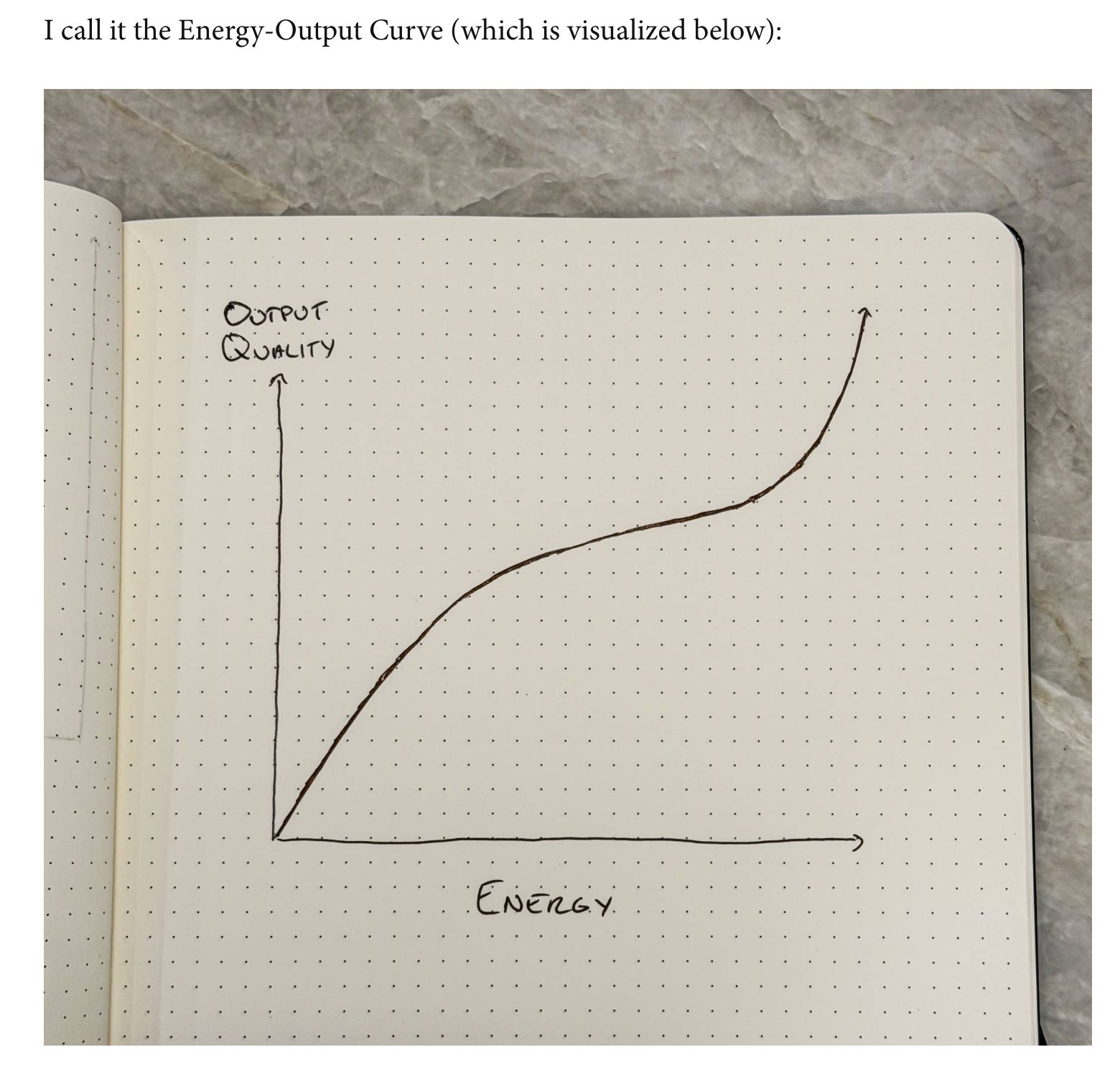
(Image Source - The Energy-Output Curve by Sahil Bloom - highly recommend you read it!)
His idea is that effort and quality don’t move in a straight line, and that the relationship has a shape to it with three parts.
There’s the activation phase at the start, where a small amount of energy gets you a huge jump in quality, and it’s exciting because progress is fast and obvious. (Spinning up a website for fun, anyone?)
Then there’s the valley, the long grinding middle where every extra bit of effort buys you less and less, the work stops being interesting, and the dopamine drops.
And then there’s the final 5%, where quality suddenly surges again. His point is that most people never get there because they quit somewhere in the valley, and he says it’s because they’re staring at the outcome and the outcome has stopped paying them back. (Think Instagram likes and followers just plateau, dopamine drops.)
That’s his framework and I never would have found those words on my own. Also because I am nowhere near as eloquent as him. But there is a part of that journey, that curve, that really feels like mine, and it’s the reason I’m writing this piece.
AI is REALLY good at the activation phase
Think about what a chat window actually does for you and how that is vastly different than a google search.
It gives you that first surge of dopamine, instantly and for free (or a $20 pro subscription), a complete and polished plan in about thirty seconds, and it costs you almost nothing spin up. That’s the activation phase, on tap, all day. That’s scary.
And doesn’t truly prepare you for the valley, which is where all the real work lives, unfortunately for me. The valley is making the calls, sending the emails and LinkedIn DMs nobody answers, being told NO by people you respect (or don’t). AI can’t do any of that for you and it probably won’t (minus automated outreach campaigns, which quasi count as the valley, but for another time).
So here’s what happens to people like me. We hit the valley, it stops feeling good, and instead of pushing through it we quietly go back and run the activation phase again. New thesis, new analysis, new plan. And it feels AMAZING, because that part of the curve always does.
Those months on accounting firms weren’t me being stuck. I was running the activation and truly in the valley too, speaking to brokers, looking at CIMs, getting on calls, connecting with firm owners. It was progress, but it stopped pretty quickly. In part because it was hard but really, because the activation phase got it pretty wrong for me and it took starting in the valley to figure that out.
The thing I cut, and what happened
Last edition I told you I was doing a little bit on Instagram, that I really didn’t like it, and that I had no idea if I’d stick with it.
I deleted it, and I felt better within minutes.
Thinking back to Sahil’s piece, this is why I think it worked. Instagram was another activation phase (although I really did get learnings on public speaking and stepping out of my comfort zone). But it was truly quick hit, instant feedback. And when I took it away, the hours went somewhere else. I read more, I actually prospected, I did outbound, set meetings, I talked to real people who might become clients, I was told no. And learned where my business model for AI consulting has some REAL flaws.
That’s all valley work. Boring, slow, nobody’s clapping (except me). It’s also the only work that’s ever moved this business and growing process an inch.
Why this is so much worse for people like me
Okay so here’s the part that I feel uncomfortable sharing, but is true.
I’m good at learning. When I worked with a coach that was some of the clearest feedback she gave me, and she meant it as a compliment, and it IS a strength. It’s why I was always the swiss army knife at work, especially in Tech. Something breaks, swoop in, figure out what’s actually wrong, figure out how to fix it, get people who never talk to each other working together. That’s been my whole career. And I’m pretty good at it.
So what happens when you hand a person like that a machine that does cross-functional analysis on steroids, instantly, for free (or semi-subsidized), forever?
You get me, months deep in the wrong industry, with a beautiful thesis and a machine cheering me on. But looking at businesses that were just not the fit.
There’s a Harvard Business School study that’s pretty interesting. Knowledge workers using AI finished tasks 25.1% faster and produced 40% higher quality work, which sounds great, except accuracy dropped 19% the second they trusted it uncritically on the wrong kind of task.
So it made them faster and it made the work better and it also made them more confident about being wrong, and that last part I’m always worried I am vulnerable to.
It agrees with you, and that’s no good
Stanford tested eleven of the big models this March and found they affirm what we’re doing about 49% more often than an actual human would. But the flattery isn’t the scary part, the scary part is what the flattery did to people. The ones who got the agreeable AI ended up more certain they were right and less willing to change course, which is a pretty good recipe for getting stuck, and I was stuck for months.
It’s also a good recipe for ruining critical thinking, and that scares me as a parent, but that’s a whole newsletter for another time.
There’s a newsletter I read this weekend called AI Skill of the Week and they have a name for this that I love. They call it the Yes-Man Loop. You share a plan, the AI says it’s solid, you feel good, and then two weeks later the plan falls apart and nobody ever told you what was wrong with it, including the AI you asked.
Which is why I show up here every week
I write this thing every single week. Some weeks it’s great, some weeks it’s average, and honestly I have no idea which it’s going to be when I sit down and start to brainstorm.
I keep doing it anyway, and it’s less about discipline and more that it’s the only way I can prove to myself that I’m still in the valley and haven’t quietly wandered out of it. This newsletter is my accountability, out in public, where I can’t pretend otherwise.
If you’re building something you probably need your own version of that, some thing you keep doing whether or not it’s working yet.
3 things I do now
None of this is complicated and all of it is free. It’s what I have found to help me prevent the “Yes Man Loop.”
1. Push back on it every single time.
Every session, not just when I remember. I ask some version of these three and I don’t move forward until I have:
Tell me where the holes are.
Tell me if you’re telling me what I want to hear.
Tell me where this doesn’t work.
I can’t even begin to tell you how many times that helped me out.
2. Build the pushback into the tool so you don’t have to remember it.
This is a bit next level, but worth it if you are playing around at all in Claude Cowork or just using Projects in Claude. This past week I built a skill whose whole job is to refuse to agree with me and refuse to sugarcoat anything.
I got the idea from AI Skill of the Week, and their version is free and sitting right there on GitHub, and it’s really good. It runs an assumption audit, it takes your logic apart, it names the actual bias you’re running on (sunk cost, confirmation bias, planning fallacy), and it ends with one uncomfortable question you can’t dodge.
Build your own version around whatever YOU are most likely to lie to yourself about. Mine is built around the fact that I fall in love with an analysis.
3. Decide what you’ll DO with it, and decide when you have to stop.
This is the one I’m struggling with, and candidly found myself not following a few times this week alone. Research has no natural end, it’ll expand to fill every hour you have and feel productive the entire time, and the machine is never going to turn to you and say okay that’s enough, go call someone, go do THE thing.
So before I sit down with it now I write two things down. What action comes out of this, and when I have to close the laptop and go do something in the real world.
Then at the end of every day I write three things I gained that day, usually work but sometimes personal, and three priorities for tomorrow. (I stole this from The Gap and the Gain, by Dan Sullivan and Benjamin Hardy, and it’s one of the only things from a book I’ve actually stuck with.)
Three gains, three priorities. It’s almost embarrassingly simple, and it’s the most useful habit I have because it’s the only thing that shows me I’m getting traction instead of just getting smarter.
So what do we do with this
Start. I still mean it, last week’s six moves still hold.
But go in knowing that the smartest model you’re working with (and crazy to think this AI model is the dumbest it will ever be) has one very specific bias and it’s toward agreeing with you. Use it to think, but don’t use it to decide, and don’t let it be the thing that tells you you’re ready, because it will tell you that every single time. And it will mean it, and it will be wrong. Trust me, I have probably lost what amounts to weeks by using Claude too heavily.
The activation phase is free now and everybody gets access to it because of the models. Which means the the game must move to the valley, and almost nobody is in there, or stays there long enough. Because its HARD.
Save this one. And if you’re the friend who’s been “looking into” something for two years, maybe send it to yourself.
I’ll see you after carpool.
Danielle
I relate to this so much! Claude and I have come up with so many great ideas, but goodness, I'm struggling on the execution part, and honestly kind of getting addicted to that dopamine high of brainstorming new versions of my ideas with Clause.