
Guide 4: Your Company Gave You Claude. Then You Caught Yourself Talking Like AI.
Steal my workflow. Learn how to train Claude to write in your voice so that you can still be authentically YOU.

Your company gave you Claude. Then you caught yourself talking like it.
Guide 4: the file that keeps your writing sounding like you, and the loop that keeps it honest.
I write my Notes on Substack the old-fashioned way. I sit down with my pillars in front of me, I don’t open anything else, and I just write. It’s a good exercise and I like doing it.
Which is why it freaked me out a little when I started finding AI-isms in my own writing. “It’s not X, it’s Y,” sitting right at the front of a sentence, unprompted, from ME. Then I caught myself saying it out loud in a real conversation. I’ve been reading so much AI this year that I’ve started to sound like it, and I’m the one who’s supposed to be catching this stuff. (I wish I was making this up.)
Here’s the part I’d rather skip. I’m not the best writer. When I started the newsletter I leaned on AI to get me going, and a big reason I can write more naturally now is all that back and forth - draft it, rework it, look at what I changed. So I’m semi-okay with how I got here (and I’d do it the same way again). What I’m not okay with is sending something out that doesn’t sound like how I’d really write and talk.
I can also tell when someone else hasn’t done it well. I’ll be reading along and get to a story that’s technically right but not personal enough, where the perspective is so general it could be anybody’s, and I get the ick and I skip it. IYKYK. That reader is me, and that reader is also everyone on your list and everyone who opens your business review. And if you’ve started catching it in your own writing, same.
(New here? Guide 1 builds your second brain, and its My Voice page is the file this guide sits on. Start there.)
Nobody is putting spell check back in the box
Everywhere you look right now, someone is telling you to stop writing with AI. I think that’s wrong, and I’d be a hypocrite anyway, because I use it every single day.
Telling people not to write with AI is like telling them to turn off spell check. Of course you’re going to run spell check before you put something out.
And the output is GOOD, which is exactly what makes this tricky. It tightens up the sentence you would have shipped anyway, and it flows better than your third paragraph was going to. What it can’t do is have your judgment, so what comes back is the average of everybody, and the average of everybody is what I scroll right past.
Alex at Tenex changed how I think about this. He built an amazing newsletter and now he runs an AI agency putting this stuff into some of the largest companies in the world, and he walks through exactly how he balances his own voice against the things he cares about when he writes. Watching someone that good at this use AI on purpose was the thing that did it for me. All we see online is AI slop, AI this, AI that, and I get nauseated by it too, but it’s a tool, and the question is how you use it and how much intention you bring. The voice-file idea itself I took from Ruben Hassid (I am just a text file, and it’s not X, it’s Y is the best list of the giveaways I’ve seen - I highly recommend both). I didn’t invent any of this. I just run it.
The only test I trust: would I say this out loud?
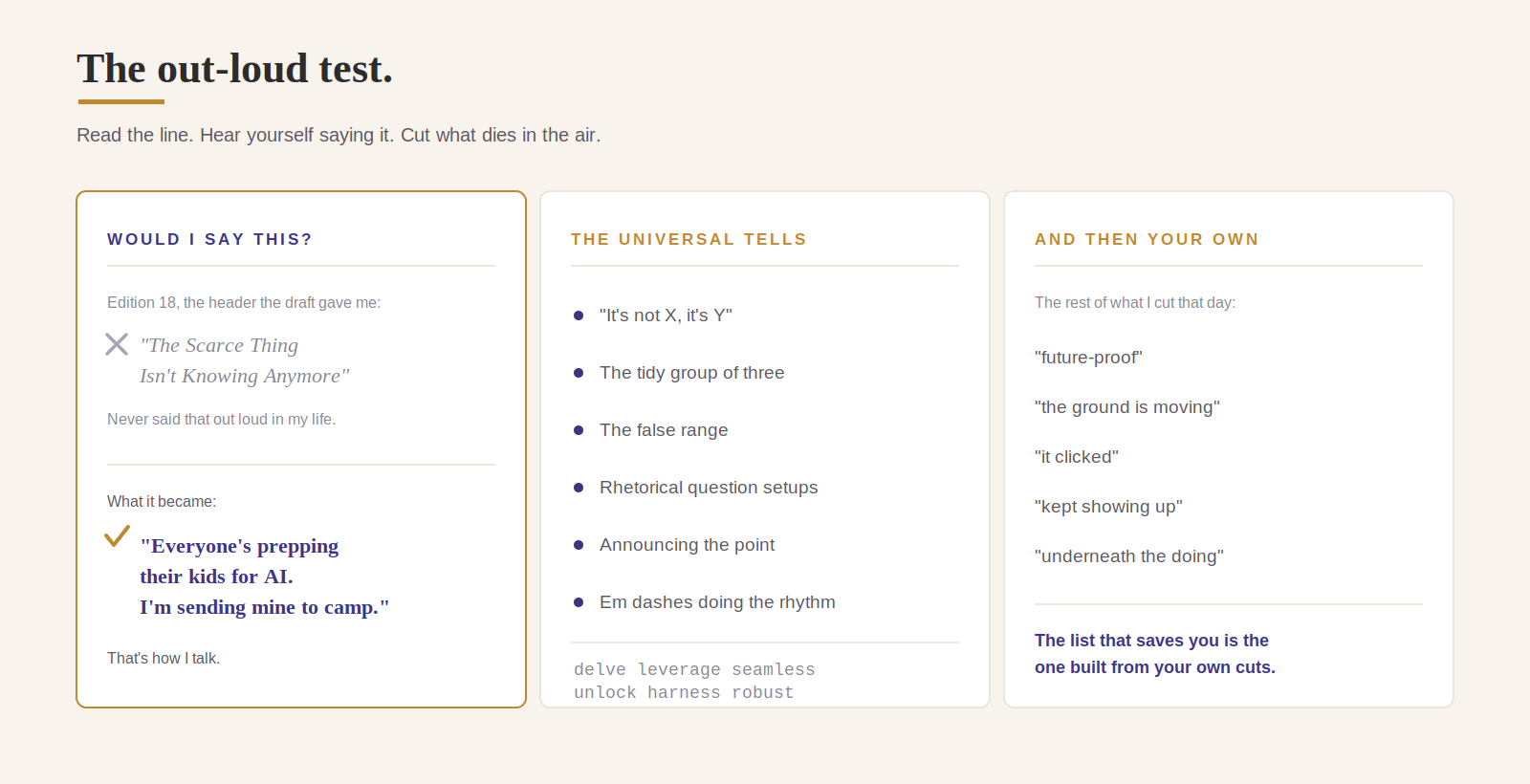
Here’s a real example I’m going to share. My last edition, the camp/color war edition. The draft came back with a header that said “The Scarce Thing Isn’t Knowing Anymore.” Like, I would never say that. Not to you, not to a friend standing outside at school pickup.
What I would say, and what the edition ended up being called, is “Everyone’s prepping their kids for AI. I’m sending mine to camp.” That’s how I talk. It also happens to be what the piece was about, and that’s the other thing that goes wrong when a line isn’t yours: the wrong header had moved the entire edition onto a topic I wasn’t even writing about.
Same pass, I cut “future-proof,” “the ground is moving,” “it clicked,” “kept showing up,” and “underneath the doing.” None of them are bad writing. They just sounded finished before they had a thought in them, and every one of them failed the same test - I read it, I heard myself saying it, and it died in the air.
Ruben’s list of the universal tells is worth knowing (the “it’s not X, it’s Y” flip, the tidy group of three, the em dash doing rhythm work nobody asked for, the puffed-up words). But the one that’s the most meaningful for me is the one that’s based off the sentences I have literally cut out of my own editing before, because if I don’t do that, it’s possible they’ll pop right back up. And I don’t want that to happen.
Three steps, and the third one is why I wrote this
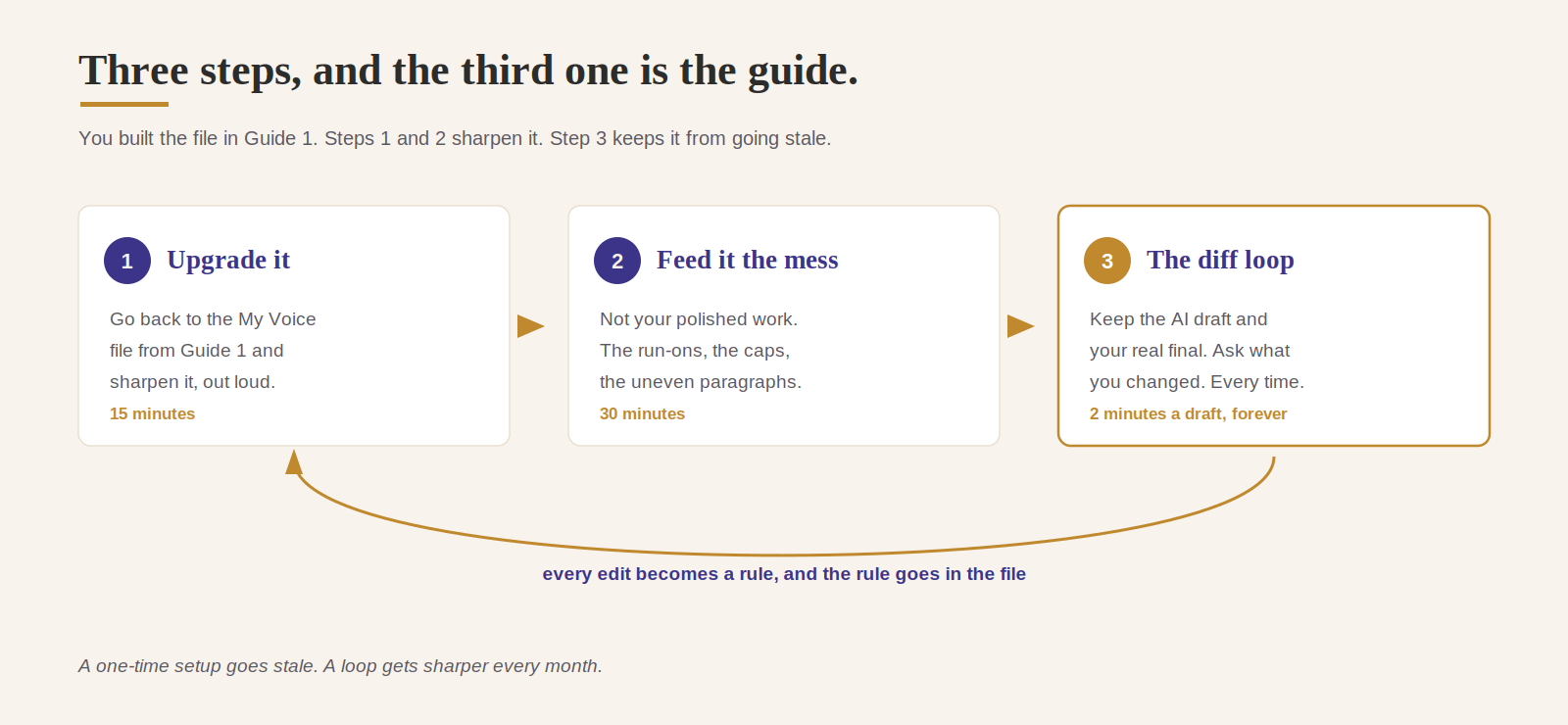
Step 1: Upgrade the file you already built
Guide 1 had you make a My Voice page. It’s version one and it’s supposed to be thin, so what we’re going to do here is go back, tighten it, and make it even more meaningful.
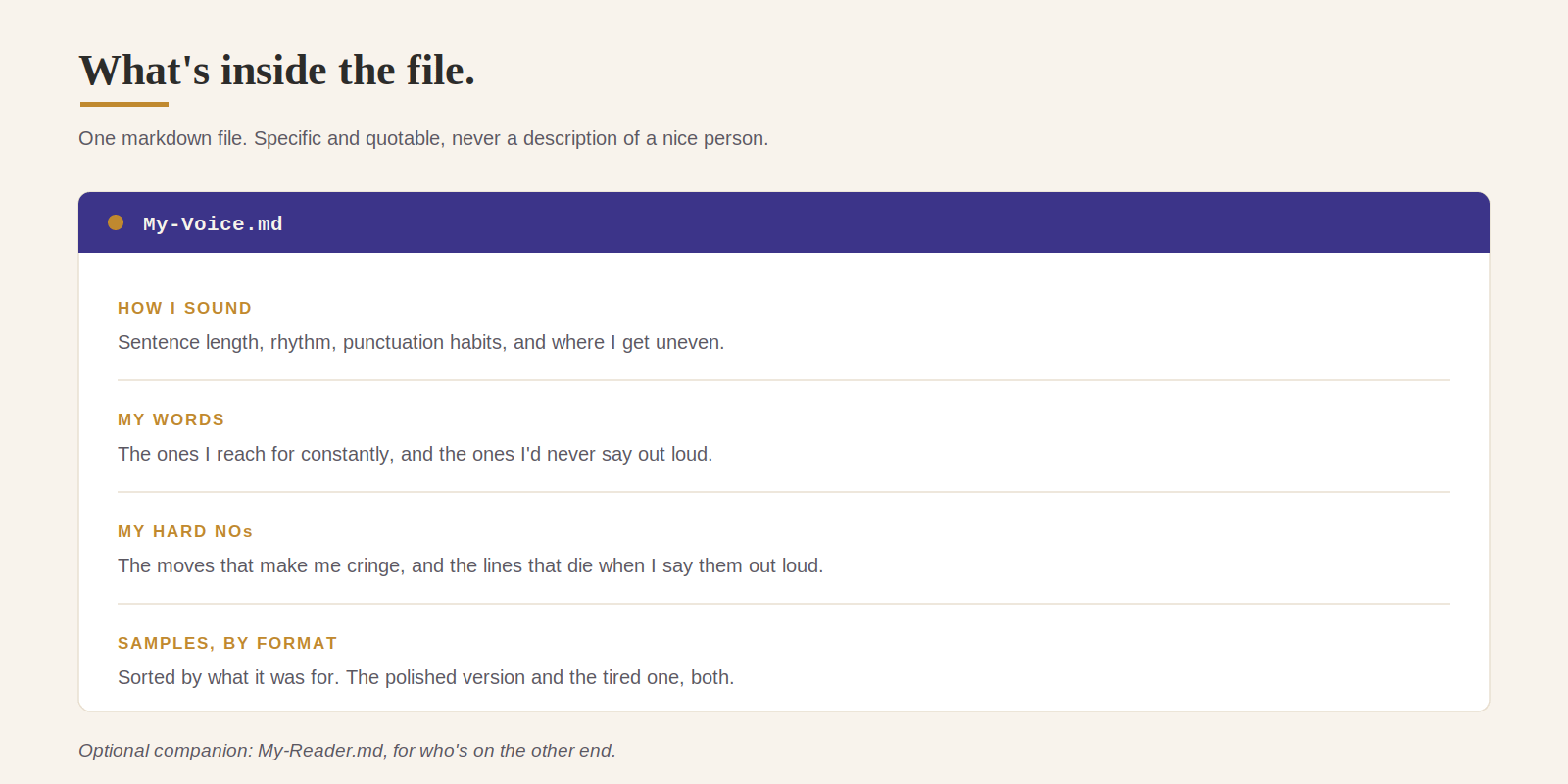
Open my My Voice file. Interview me to make it sharper, in small batches, and I’ll answer out loud. Cover the words and phrases I use constantly, the ones I’d never say, my hard NOs, and what I refuse to sound like. Keep it specific and quotable, not a description of a nice person. Where I’m vague, ask me again.
Answer by talking, not typing. The way you talk IS the raw material, and typing cleans it up before it ever gets to the page.
Step 2: Feed it the writing that isn’t smooth
Most people upload their three most polished pieces and then wonder why what comes back doesn’t sound like them. No surprise. Polished writing is where you sound the most like everybody else.
When I looked at my own writing, it was crazy run-on sentences. Some of them are super choppy. I had caps in there from when I was VERY excited. The flow was weird in some paragraphs and honestly horrible in others. And that talks like me. I talk very fast, and it turns out I write fast the same way. All of that is the part that sounds like me, and it’s the first thing a model tidies away if you don’t tell it not to.
So give it the diversity - the range of how you talk and how you write - sorted by what it was for. I use AI hardest on the two places where it matters most for me: getting something complicated across in a business review, and writing the copy for my own website so it still sounds like a person wrote it. Yours might be the update to your manager, the exec summary, the doc where you’re making a hard case. Give it the good version and the tired version of each.
Here’s a batch of my real writing, sorted by what it was for. Read it against my voice file and add what you find: sentence length and rhythm, punctuation habits, how I open and close, my go-to words, where I get uneven, and anything I never do. Show me the additions before you write them in.
If you talk more than you write, feed it voice notes. A transcript of you thinking out loud is the least edited sample of yourself you own.
(Optional, and worth ten minutes: a second file for who’s on the other end. I keep one for my newsletter reader, because writing that sounds like me but lands nowhere is still a miss.)
Step 3: The diff loop
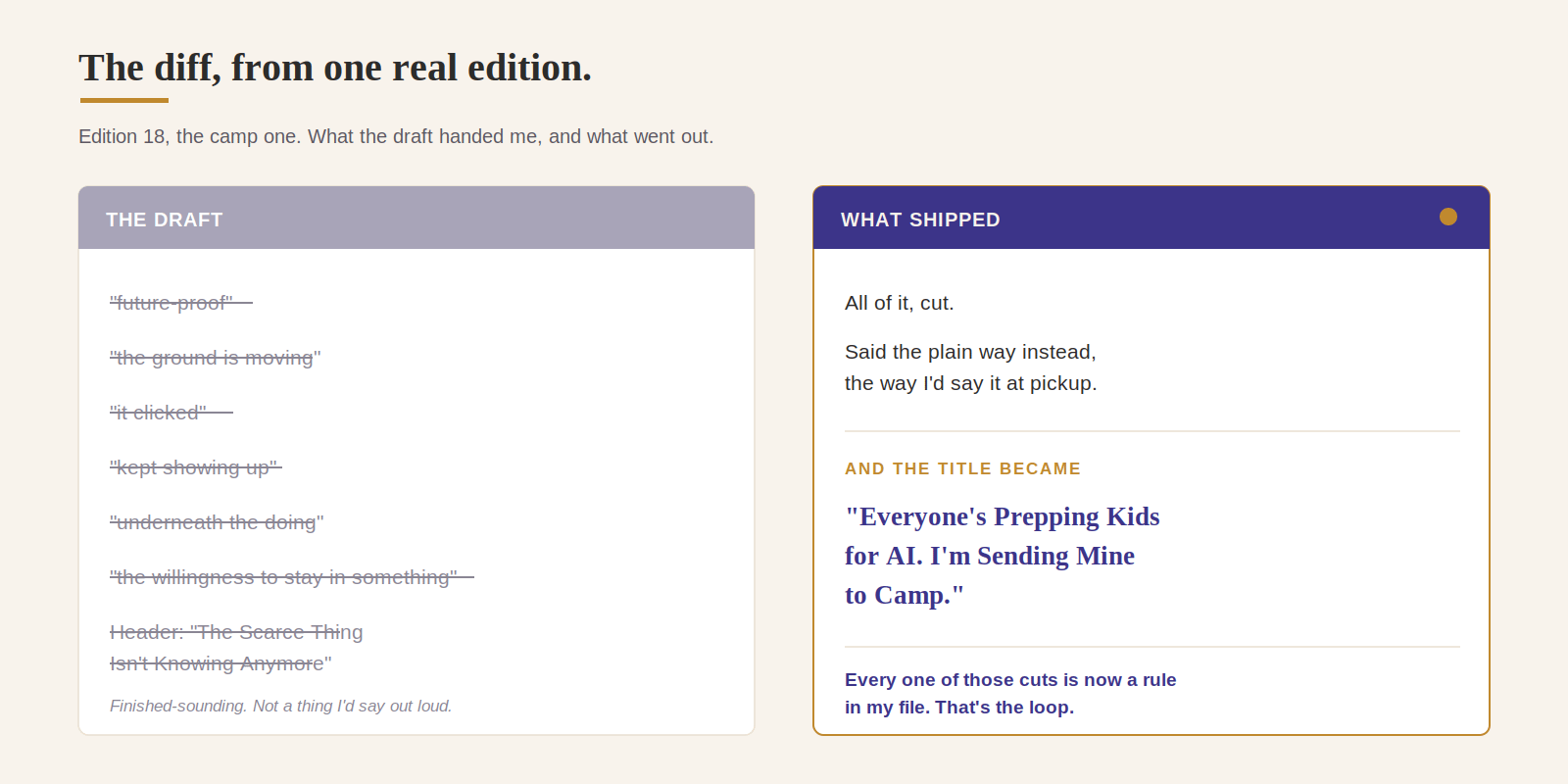
Every time I let AI draft something, I keep the draft. Then I rework it, again and again and again. And my version comes out different in ways I couldn’t have described to you in advance, so I hand both back and ask what changed.
I’m giving you two versions of the same piece: your draft, and my final after I reworked it. Compare them line by line and tell me what I consistently changed - word choices, sentence length, what I cut, what I added, what I softened. Write the patterns as rules in my voice file, and if you see the same pattern twice, mark it confirmed.
The answers become my own rules, the rules go back in the file, and the next draft starts from a version that took into account all of my ways of not talking. That’s what makes sure that every single time I sit down to write something meaningful in long form, it’s really writing how I would naturally write.
Mine is a real file with a date at the top and a log at the bottom (it’s called AAC Voice Edit Tracker, which is not a super cool name, but it works). It’s how I know things about my own writing that nobody ever told me: that I break a long sentence with a spaced hyphen and never an em dash, that I add a caveat in parentheses so I don’t get misread, that after I admit something hard I always turn it forward. I didn’t know any of that about myself until the diff showed me, twice.
What this is protecting
Use the tool, run the spell check, let it tighten your sentences.
But what you’re building underneath all of it is the version of you that’s portable - your judgment, your taste, the way you land a point. That’s what walks out the door with you when the title changes or the org chart moves, and it’s the one thing on your laptop that can’t be regenerated. Protecting it is the same as protecting whether people trust you, because a reader who clocks you as generic doesn’t argue with you. They just skip you, the same way I do.
So go find your My Voice file from Guide 1 and give it fifteen honest minutes out loud (fifteen, that’s it). Then the next time you let AI draft something real, keep both versions and ask it what you changed. That second habit is the one that compounds, and it costs you about two minutes a draft.
Save this. Send it to the person on your team whose messages have started to sound like everybody else’s.
If I made the full version of this, templates and the full system, would you want it? Hit reply and tell me which part.
I’ll see you after carpool.
- Danielle