
Guide 3: Your week is already your newsletter. Here's how to publish it.
A guide on how to get started writing your own Newsletter. With the system I actually use.

Your week is already your newsletter. Here’s how to publish it.
Guide 3: the weekly AI system that turns your real life into an edition that sounds like you.
I run an AI and fractional COO agency, and on the side I’m looking at some business investments. This newsletter is just my pastime, the fun thing I do that has nothing to do with either.
Which is kind of funny, because writing was never my thing. I was a math and science kid who dreaded every paper in school, and I still think way faster in numbers than in words.
So when I started AI After Carpool, the writing itself wasn’t the scary part. The scary part was doing it again the next week, and the week after that, when I’m already running a company, looking at deals, raising three kids, and it’s 9pm with nothing left. That’s where most newsletters die, on the week you’re just too fried to write one.
Most people just open a blank chat and ask AI to write the newsletter for them. I get why, but you can always tell. It comes back smooth and fine and sounds like nobody, and nobody forwards that.
So I do it almost backwards. I don’t start with AI, and I don’t end with it either. AI sits in the middle. First I pump in a ton of my own stuff, the real moments from my week, my actual take, the way I’d say it out loud. Then AI takes all of that and writes the first draft. And then the real work starts, where I go back through the whole thing and rewrite it the way I actually would, like an editor with a red pen. The start is me, the middle is AI, and the end is me again.
This is all of it, the real steps, the actual prompts, and one new piece I’m still testing that I stole from someone in the content world. If you’ve been meaning to start a newsletter, or you’ve got one and every week feels like starting over, this is how I’d do it.
(New here? This works on its own, but it runs on the second brain from Guide 1. If Claude already knows your voice and your reader, all of this gets sharper.)
First, the one idea it all runs on
You feed it, and you finish it. AI just drafts the middle.
The stuff that used to stop me from hitting publish, figuring out what to write, staring at a blank page, the endless title tweaking, AI can carry all of that. But the two things that actually make it mine, everything real I put in at the start and the full rewrite at the end, never leave my hands. AI gets the messy middle, and it never gets the first word or the last word.
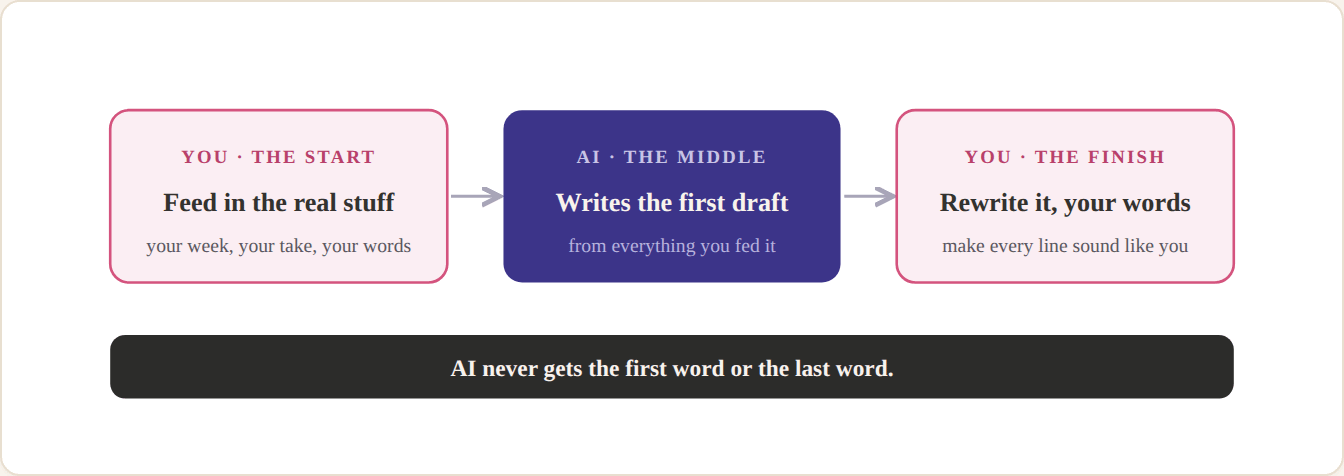
Every step below protects that. This isn’t about handing your newsletter to a robot. It’s about owning the start and the finish, and letting AI take the slog in between, so you never face a blank page and you’ve still got energy left for the part that makes it yours.
Wait, what’s a “skill”?
I’m going to say the word skill a lot, so here’s the quick version. A skill is a saved job you run with a slash command: you type /, pick it, and Claude does that one task the same way every time, no re-explaining. You set it up once and you’re done.
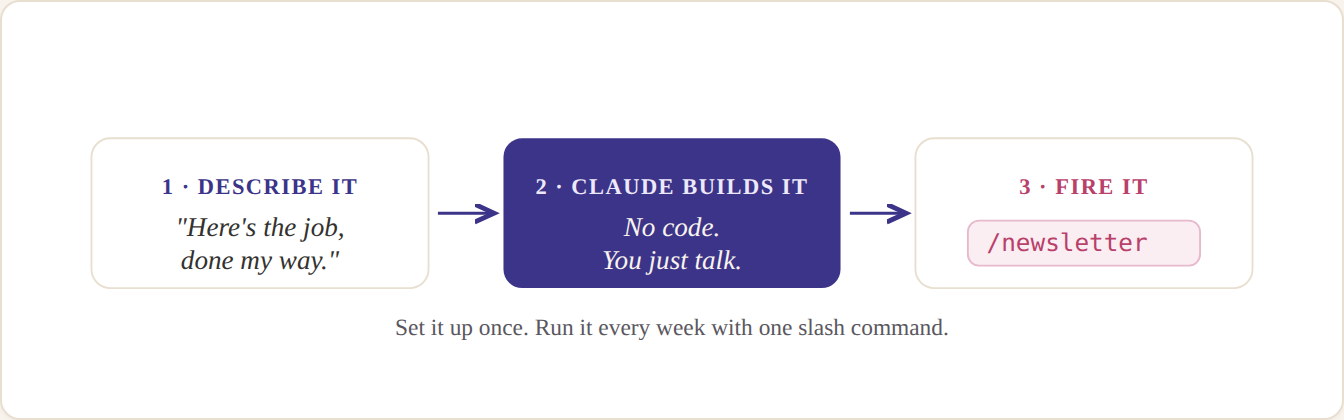
You don’t code it, you just talk. Tell Claude what you want it to do (run /skill-creator), or when it nails something, say “save this as a skill.” That’s it.
This matters for a newsletter because it’s the same few jobs every week: find the topic, pick the title, sharpen the take, draft it, edit it, publish it. Turn each one into a skill, and your week stops being “write a newsletter from scratch” and starts being “run down the list.” The system gets it out the door, not whether you feel like it on a Tuesday.
The whole setup, on one page
It’s a chain of small skills that hand off to each other, six skills and one habit, and most weeks I’m not even thinking about it, I just run it.
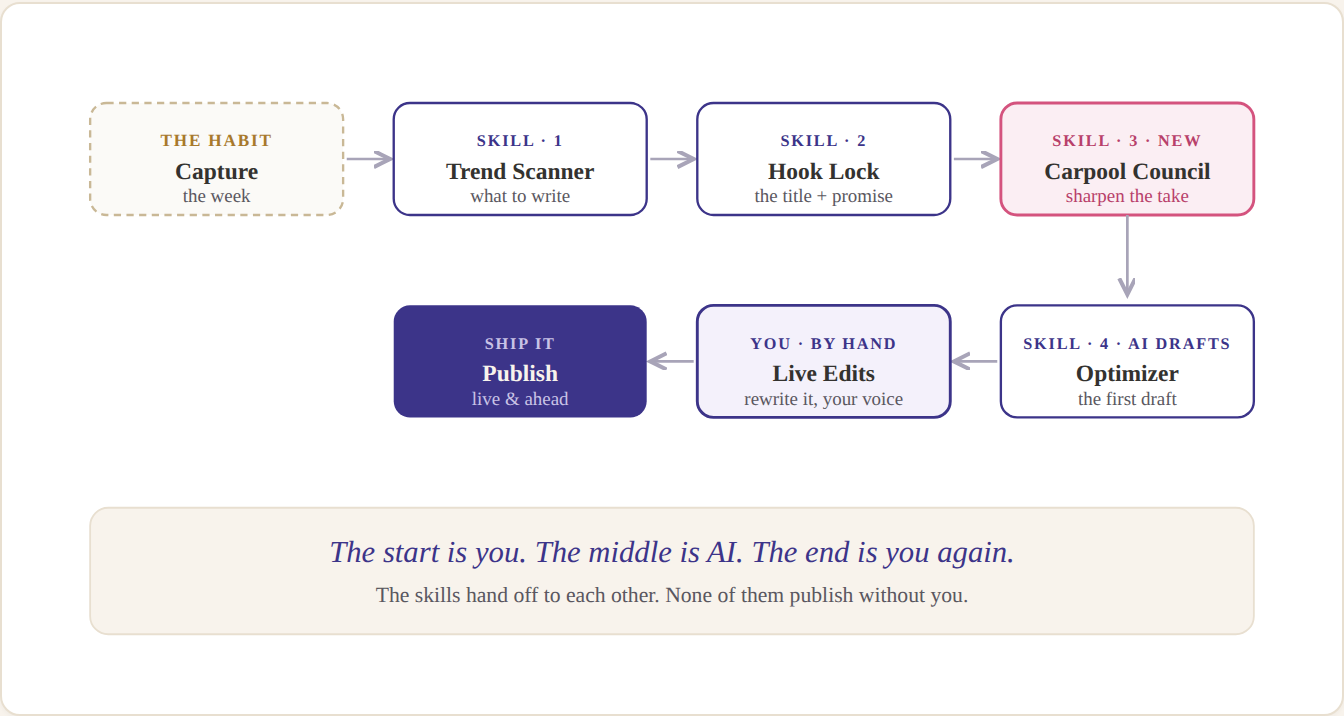
Every step is only as good as what the one before it handed over. Let me walk you through mine.
Step 1: Document the week (a habit, not a skill)
Honestly, everyone skips this step, and it’s exactly why their AI drafts come out flat. I skipped it too at first.
Now I leave myself a trail all week. Not a journal (I’d never keep a journal), just little breadcrumbs I drop the second something happens: a line one of my kids says in the car, a screenshot of something I saw waiting at pickup, two sentences I thumb into my notes app because a work thing suddenly clicked with a parenting thing, a photo of a page in whatever I’m reading.
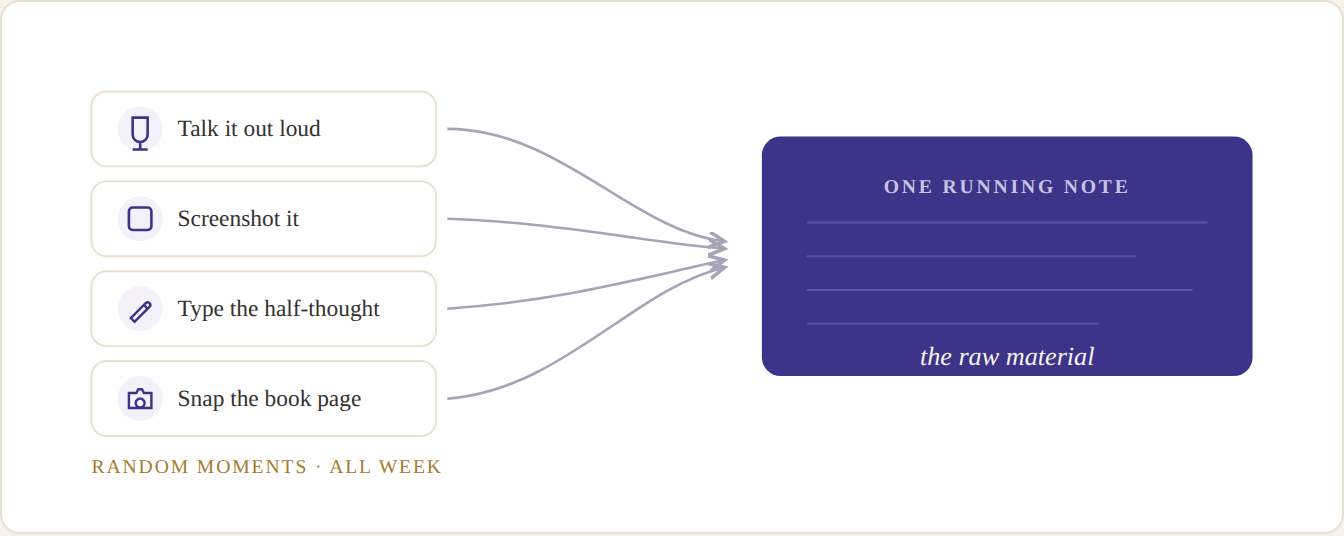
A draft comes out generic when you didn’t give it anything real to work with, so it grabs the most average version of your topic and runs with it. Specific beats smart every time, and while AI can polish all day, it can’t make up the thing that actually happened to you on Tuesday, because it wasn’t there. You were.
So catch it in the moment, and talk it out instead of typing it, because you talk way faster than you type and the messy stuff you’d never bother writing down is half of what makes it sound like you. Dump it all in one note, wherever you already live, and by the weekend you’re not staring at a blank page, you’ve got a pile of real stuff to pull from.
Step 2: The Trend Scanner (what to write about)
I read a lot, Justin Welsh, Sahil Bloom, James Clear, a bunch of AI newsletters, plus whatever’s blowing up that week. But a pile of stuff I read isn’t a topic, and what I needed was a way to cut through all of it and land on the one thing actually worth writing about, for my reader.
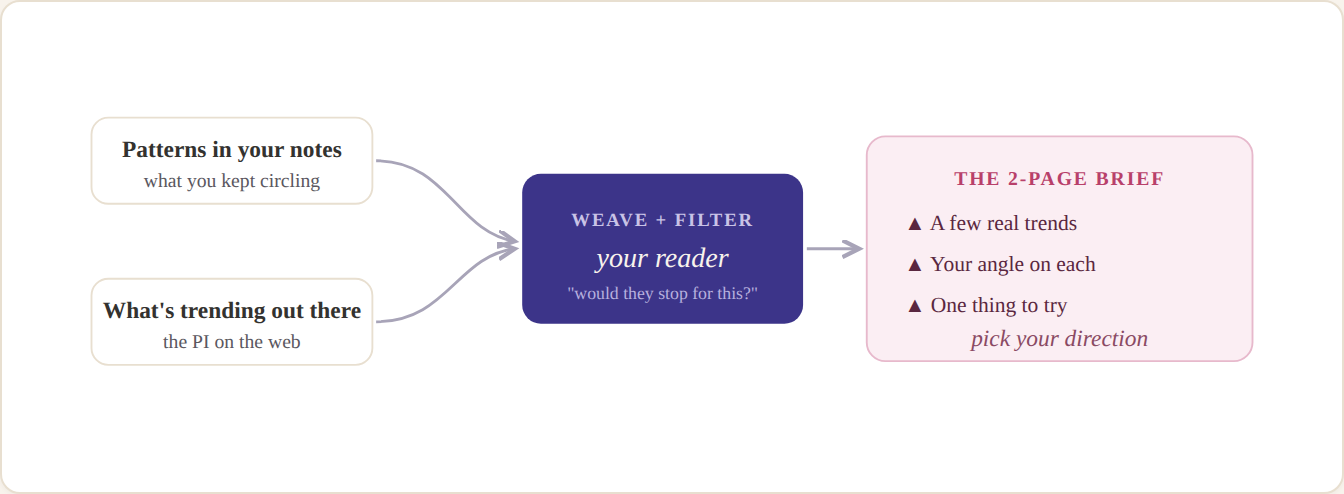
A trend scanner is a skill that works like a little research assistant you send out every week, and it does two things at once. It plays private investigator on the internet, hunting down the news and conversations that are actually trending in your corner of the world. At the same time, it reads back through my own notes from Step 1 and finds the patterns I didn’t realize I kept circling. Then it weaves the two together, what’s moving out there and what’s already on my mind, because spotting patterns and connecting dots is the one thing AI is genuinely great at.
The other half of it is the reader. Mine’s built around one person, Megan, and I’ve got her written down in detail, what she wants and what she’d roll her eyes at. Every trend has to get past her: would she stop for this, could she use it by Friday, does it make her feel more capable instead of more anxious? If it can’t pass Megan it’s out, and that’s what turns “here’s what’s trending” into “here’s what you should write.”
Build a skill called trend-scanner. When I run it, search the web for what’s
happening this week in [your topic], but filter everything through my specific
reader: [a short description of who they are, what they want, what they’d
never care about].

Hand me a short brief, two pages max:
- The top 4 or 5 things worth writing about this week, plain language,
  opportunity-first, never fear-first.
- For each, the specific angle for my reader and the one concrete thing they
  could actually do with it.
- Any expert or named source that makes it credible.
- End with 2 or 3 mapped into a rough direction, plus a few possible titles.

Also read my running notes from this week [point it at your capture doc] and
weave in anything I captured. My real moments beat anything online, lead with
those where they fit.
Then I read the brief and pick a direction, not the final title yet, just what this week’s about.
Step 3: Lock the hook before you write a word
I did this backwards for months. I’d write the whole newsletter and then try to come up with a title at the end, which is a bad idea, because by then the thing’s wandered all over and you’re just slapping a title on whatever came out.
So now the title comes first, and it’s its own skill. I lock the title and subheader before I write a word, and everything after that gets built to pay it off.
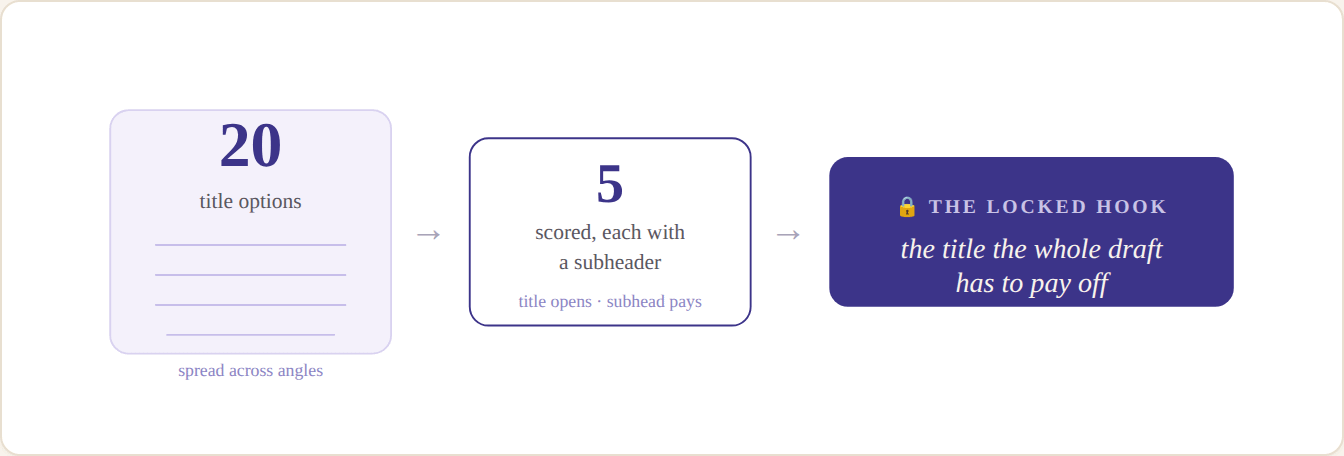
The skill spits out about 20 titles across different angles (not 20 versions of the same one), scores them, and gives me the best 5, each with a subheader. The subheader matters more than you’d think, because the title makes you curious and the subheader tells you what you actually get. And one thing I learned the hard way: the title that sounds best isn’t always the one you have the most to say about. So I hold the 5 and lock the real one in the next step, after I’ve heard myself talk.
Build a skill called hook-titles. From this week’s trend brief, generate 20
title options across different angles, not 20 versions of one idea. All in my
voice, nothing that sounds like a guru or a LinkedIn hustler.

Score them and give me the top 5, each with one or two subheaders. The title
opens the curiosity, the subheader makes the promise concrete. Recommend one,
tell me why in two lines. Invent no detail, story, or number that isn’t real,
flag it instead. Hold the 5 as candidates. I’ll lock one after the interview.
Step 4: The Carpool Council (the new step)
This is the piece I’m most excited about, and it’s new, so fair warning, I’m still testing it. I stole the idea from the content world and made it my own.
It’s simple. Before I write, I sit for an interview, not with a person, but with a little panel of voices I put together on purpose, and their whole job is to drag my real take out of me. I call it the Carpool Council, four seats, and it runs right after I’ve got my title options.
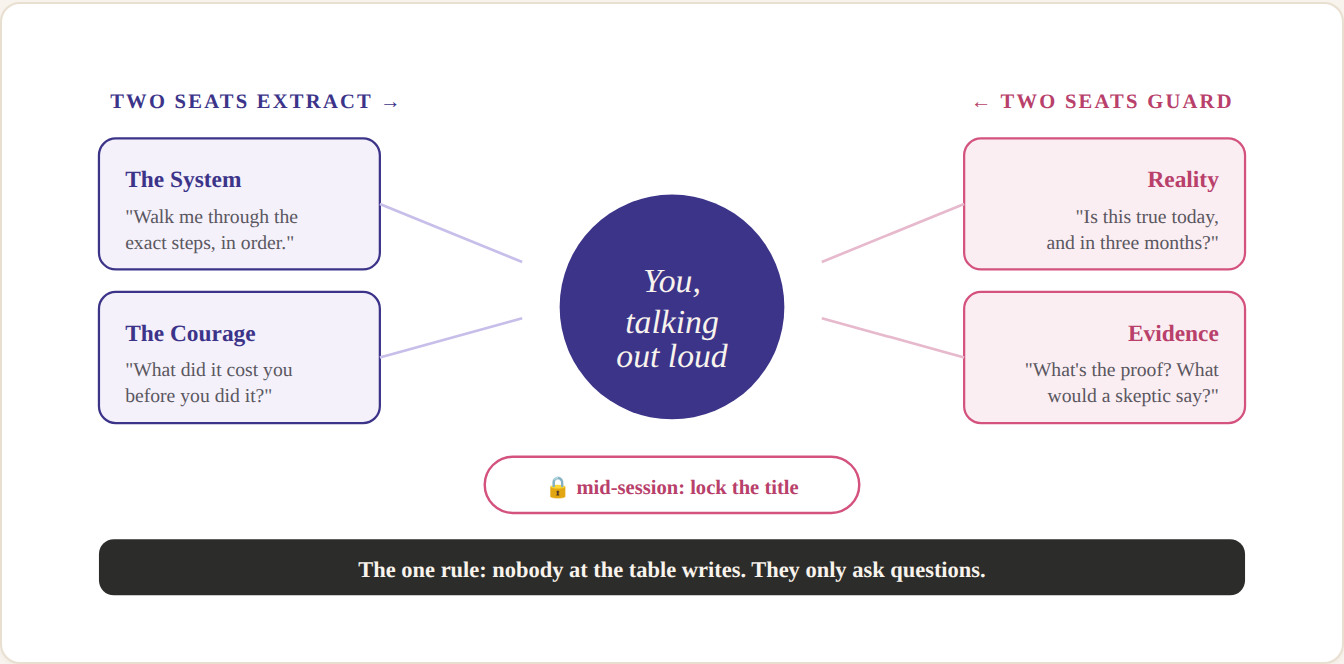
When a draft comes out boring, it’s almost never the writing, it’s that nobody pulled your real take out of you first. This gets mine on the table in ten minutes up front, instead of a two-hour rewrite at the end. The one rule is that the panel never writes, it only asks, and if a seat starts writing sentences for me, I stop it and send it back to questions.
Two seats pull the take out of me, two guard the reader. The systems seat pushes for the exact steps someone could copy, which tool, what I did first, what the prompt actually said. The courage seat asks what it cost me or scared me before I did it, which is where the honest part comes from.
Then the guards come in, after I’ve talked. The reality guard asks whether this is even true today, and still true in three months. The evidence guard asks for the proof, and what a skeptic would say.
The best part is in the middle. After the first two seats dig in, the Council tells me which two or three titles I clearly have the most to say about, and I lock one. That’s when the title actually gets decided, because now I’ve heard myself talk.
And it doesn’t hand me a draft, it hands me a brief, and it’s the most useful page of my week:
LOCKED HOOK:      [your final title and subheader]
THE THESIS:       [your take, your words, a sentence or two]
THE PROOF:        [the specific story, example, or number behind it]
THE MECHANICS:    [the replicable how, from the systems seat]
THE EMOTIONAL     [the cost, the stakes, the real moment, from the
CORE:              courage seat]
THE HONEST        [the limit, the caveat, the counter-argument you’re
CAVEAT:            not dodging, from the guards]
THE READER        [what your reader walks away able to do]
PAYOFF:
RAW QUOTES:       [3 to 6 of your own lines, word for word]
That RAW QUOTES section is a week of social posts sitting right there. Don’t mine your finished newsletter for social later, it’s already been smoothed out, so mine the interview instead, because what you said out loud already sounds like you.
Build a skill called carpool-council. Runs after I have my hook candidates and
my notes for the week. Your job is to interview me, not to write. Never draft a
sentence for me. If you catch yourself writing prose, stop and go back to asking.

Four interviewers, one at a time. Two extract, two guard.
- Extract, the system: push for the exact steps, the specific tool, the real
  sequence someone could copy.
- Extract, the courage: push for what it cost me, the honest moment, the stakes.
- Guard, reality: pressure-test whether it’s true today and in a few months.
- Guard, evidence: pressure-test the proof, and what a skeptic would say.

Run the two extract seats first, each one opening question and up to three
follow-ups, digging till satisfied. I answer out loud. Then, mid-session, name
the 2 or 3 hooks I clearly have the sharpest take on and have me lock one. Then
run the two guards against the locked take. Cap it near ten minutes of me talking.

Output only the brief: locked hook, thesis, proof, mechanics, emotional core,
honest caveat, reader payoff, and 3 to 6 of my own verbatim quotes.
Answer these out loud, by voice, so your real way of talking ends up in the transcript, because that’s what keeps the draft sounding like you.
Step 5: The Newsletter Optimizer (the draft)
By the time I get here, I’m not facing a blank page at all, because I’ve got a locked title, a sharp take, the real proof, and a handful of my own quotes. The draft isn’t starting from scratch, everything it needs I already pulled out of myself.
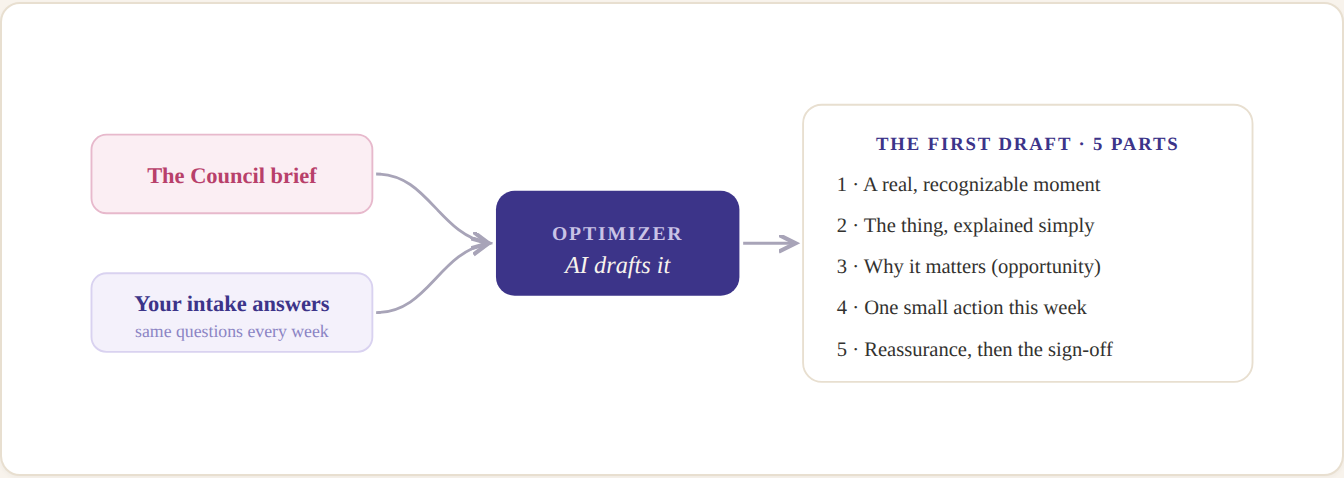
This is where AI actually writes. The optimizer takes everything I’ve fed in and turns it into a full first draft in my voice. But it doesn’t just spit one out and walk away, it runs me through a short set of questions first, the same ones every week.
It asks the stuff a draft can’t guess: the one real moment this is built on, which of my reader’s worries it speaks to, the line I want her to underline, what I want her to feel, the one small thing she can go do this week. Same questions every time, and after a couple months my own answers basically become my style guide, so the drafts get better because I’m getting clearer, not because the AI is. Then it drafts into a shape that works, and signs off the way I always do.
Build a skill called newsletter-optimizer. Runs with my Council brief and trend
brief in hand. First, interview me with a short fixed set of questions, the same
ones every week: the real anchor moment, the reader-need it serves, the line I
want underlined, the feeling they leave with, the one small action this week,
the tone, anything to avoid.

Then write the full draft in my voice [follow my Voice file], 800 to 1,200 words:
a real relatable moment, a simple no-jargon explanation, why it matters as
opportunity, one small doable action, a reassuring close. Bold the underline
line. End on a question my reader can bring to her dinner table, then my sign-off.
Use only what I gave you. Invent nothing.
What comes back is a real draft, a good one even. It’s just not done, and it’s not mine yet.
Step 6: Take the pen back (the live edits)
This is the part I actually care about, and it’s the part nobody wants to hear takes real time. The optimizer hands me a draft, and I go through the whole thing by hand, out loud, rewriting until every line sounds like me instead of some sharp stranger who read my notes and did their best.
I’ll be straight with you, because people always underestimate this: it’s not a quick polish, it’s a full rewrite, line by line, and it’s the single biggest reason my newsletter sounds like a person. Skip it to save twenty minutes and you’ve wasted everything the steps before it set up.
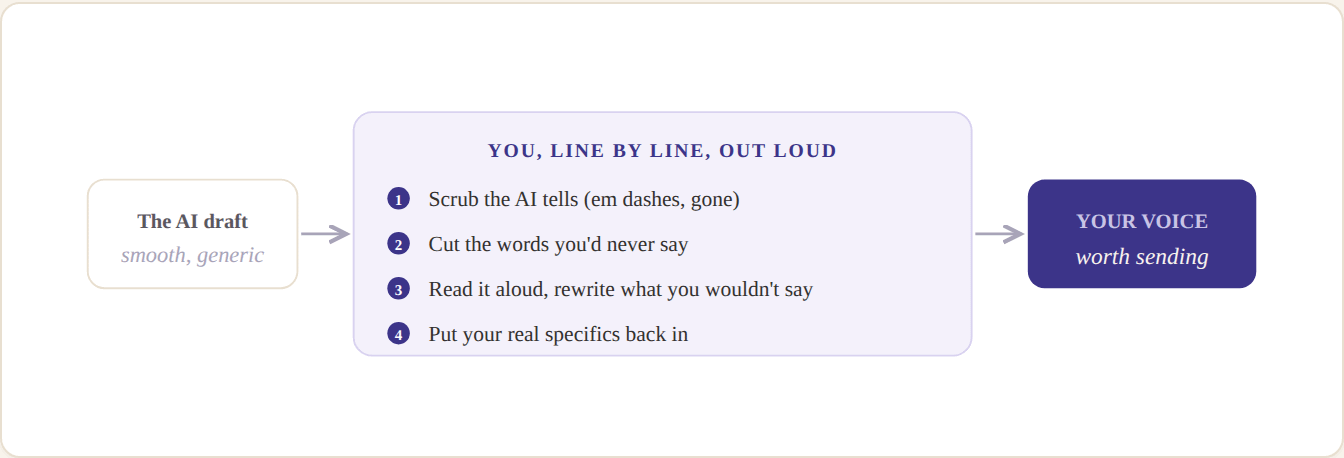
First I hunt down the AI tells and kill them: the em dashes, every one (nothing screams robot to me faster), the puffed-up words, the neat little groups of three. I keep my own list of words I’d never say, and I run every draft against it.
Then comes the part that actually matters. I read the whole thing out loud, and any line I wouldn’t actually say to a friend at pickup, I rewrite until I would. I put my real details back where it went vague, I add the aside I’d really make, the caveat it was too polished to include. I’m not making it perfect, because perfect is what the draft already was, and that was the problem. I’m making it mine.
Start your own list now, even if it’s just three words, and every draft, notice what you keep changing and add it, so that in a month the draft shows up already half-sounding like you.
Step 7: Publish it, live and ahead
Shortest step, and the one that takes the most discipline: you publish, scheduled and ahead of time, done.
The trap at the end is the same one at the start, the almost-finished draft that sits one more day, then another, until it’s stale and nobody ever read it. So I schedule the send and move on, because a newsletter that goes out on a slightly-off Tuesday beats a perfect one that never ships, every time. Then I start catching breadcrumbs for next week.
What mine actually looks like
My real week looks like this. Monday to Sunday I’m just dropping breadcrumbs, not even thinking about the newsletter. When it’s time, I read the brief over coffee, get my title options, and let the Council interview me for ten minutes, which is still the part that feels like magic, because I sit down sure I’ve got nothing and get up with a take I actually believe. The optimizer drafts it, I spend more time than anywhere else editing it into my voice, and then I schedule it and I’m done.
None of that is me staring at a blank page. I don’t start from nothing anymore, I start from a draft that’s most of the way there, and wrong in exactly the ways I already know how to fix.
Start here
Don’t go build all six skills this week, or you’ll end up with six things you kind of use and none you actually rely on.
Start with the basics: this week, just catch breadcrumbs, out loud, into one note. Next week, add the trend scanner so you’re not starting from nothing, and the week after, add the optimizer so you’ve got a draft to edit. Catch the week, scan, draft, edit, and that alone is a real newsletter going out on a schedule, which is most of the value right there. The hook skill and the Carpool Council take it from good to unmistakably you, and you add those once the rest is a habit.
Build the system, so you’ve got the energy left for the writing.
Save this. Send it to the friend who keeps saying they’re going to start a newsletter and has three dead drafts to prove it.
I’ll see you after carpool.
Danielle