
12 ways I use Claude at work, on Substack, and at home
What each one does, how I set it up, and how to copy it (if you want)

August is a month of no structure - with camps over and schools only starting the last week of August. So this year we spent a week up at the lake. Nature walks, rocks thrown into the water, in and out of the kayaks and the rowboat (my poor husband, hours of paddling). On the dock, off the dock, looking for fish, looking for frogs, reporting back. True analog summer, in the best way possible.
I sat there not doing much, which is weird for me, and thought about how much MORE everything is supposed to be right now. More tools, more skills to run, more agents, more things I could be building if I were “a really serious builder.” The online world is moving at supersonic speed. It’s exhausting.
But the best thing on that dock was how slow time was going, and how the kids were not bored with zero plans. I keep thinking the same is true for businesses right now, big and small. The old model needed a person for every function, and each of those people costs money whether the month was profitable or not (especially for smaller businesses this is HARD). That’s changing, in a good way. The busy work stops requiring a headcount (imagine if software businesses had realized growth doesn’t equal headcount 3 years ago, IYKYK), and a smaller venture can grow without taking on all that fixed overhead first. I think of our jobs, household, hobbies now as mini ventures we can grow and nurture without going at super speed.
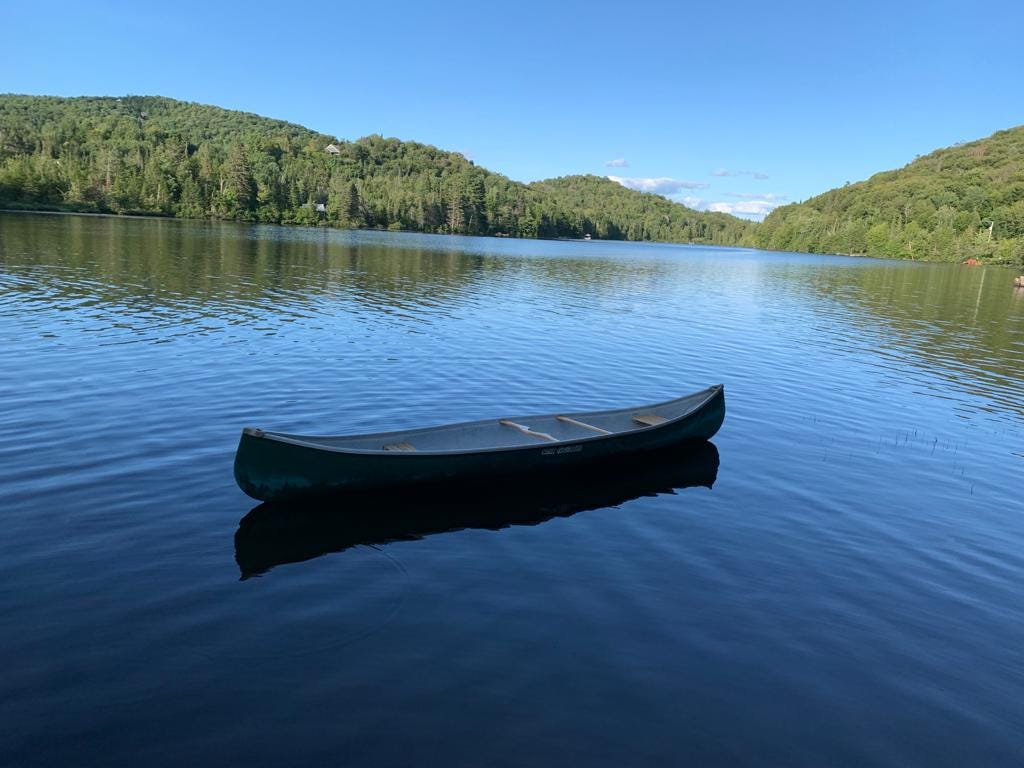
(Real lake. Real boat. Analog summers are THE thing this year).
The less is more theory is not as exciting as what’s being sold right now (total world disruption due to AI). But it’s where I’d put my money and my time. Using AI for the super boring to-do’s, rather than inventing something worth-shattering with it.
What I want out of my career changed this year and it took me embarrassingly long to notice. I’m not chasing the bigger house and the external luxuries anymore. I’m really valuing the luxury of time and health and meaningful work.
When I started this change in how I work, the hardest part was understanding how to navigate a few lanes at once (newsletter + community, investing thesis, fractional agency, and raising 3 little kids in the midst of it).
So here’s mine: twelve real ways I use Claude, at my job, on this newsletter, and in my kitchen. Steal whichever ones fit, or at least get some ideas of where to start.
One REAL risk people complain about: when you hand off annoying tasks, it’s very easy to fill the space right back up. Fair. Mostly I DO want to do more (guilty). But some of that flexibility has let me spend time on stopping, on sitting on a dock, on being more present for the kids.
The rest of my extra capacity went somewhere more important. I’m not doing as much of the annoying work (yay!). I AM doing more interesting work that I wouldn’t have gotten to otherwise, even inside my fractional work.
I set each of these up once and then mostly stopped touching them. That matters.
The deciding is the tiring part.
When I started to look at launching a fractional AI and Revenue GTM firm + looking at smaller businesses to invest in (still a maybe), I was told, and believed, most of the work was writing the outreach, building the thesis (risky for a learner like me), reading the listing.
Then I realized the REAL tiring part is from having 400 listings to look at and choosing what is even worth a look. Over and over and over. These four Claude workflows help with the decision fatigure. And I get to do the judgement part.
1. The prospect engine. It pulls contacts from LinkedIn, runs them against my ICP (Ideal customer profile) and my connectors, reads back through my old messages and emails with each person, and hands me the ten people to reach out to this week and WHY. I have a goal of a hundred reach-outs. I could always write the message. Picking the ten people to prioritize that day was mind numbing.
Yours: the same setup keeps a network warm with no job search attached. That’s most of the value, honestly, and it keeps the whole thing interesting instead of transactional.
2. Saying it simply. I use it on my own positioning, and it pushes me to say the thing in fewer words. I ramble (can’t you tell by now?). I assume people are tracking what I’m saying when they are very much not. Being pushed to say it simply has done more for me than any branding design could.
Yours: paste in the current description of the work, then ask it to keep cutting until a stranger could repeat it back.
3. The buy box. If you want to invest in something, a buy box is what the right one looks like FOR YOU. Industry, size, location. It’s a rubric. Think about buying a house: the neighborhood, the budget, whether it needs multiple floors, whether it needs a basement, how big the backyard has to be. Same exercise, different asset.
Yours: it helps with any big decision with too many options. A job search is a buy box. So is picking a neighborhood.
4. Screening the real ones. Then I run business listings against that buy box. There was an industry I was SO sure about. I signed an NDA on something I’d been super excited about, and I walked away. And to be clear, Claude was not cheering me on this time telling me this was a perfect fit (luckily its getting back) Once it had the financials it started flagging risks it couldn’t see before, and using them to help me work out whether this was a fit at all. My gut got there too. But using Claude to help me with analysis against my buy box helped a ton.
Yours: Before making a BIG change, give Claude what’s known and ask what would have to be true for this to be a mistake. Use it to help see your blind spots.
FYI - I’m also opening something small for people who’d rather build one of these with me than read about it. We set one up together, live, start to finish (the second brain first - seee #10 below, since nothing else works without it). If that’s interesting, join my Builders Subscription on Substack. If it isn’t, everything above still works on its own!
The only one who knew how.
Every task in this house comes with instructions, and the instructions live in one head. Mine. Which means I have to explain a thing before anybody else can do it, and the explaining is exhausting. This is one of those “moms, unite” moments. These four use cases got the instructions out of my head (mostly).
5. The lunch box photos. I take a picture of the lunch boxes. It remembers which combinations work, which is useful. Truly. The bigger win is that anyone here can make lunches now without a briefing from me first. That briefing is the mental load. I still am weird about giving this one up, but I have images that can feed into a menu and someone else can make them.
Yours: photograph the thing only one person currently knows how to do. Then let somebody else do it, which is HUGE.
6. The receipt. I order school lunches ahead and then at night I’d lose track of whether I’d done it. I try to stay off my phone before bed (the blue light thing), so my options were: open the phone, log into the app, get through the password, wait for the face ID, click the schedule, click the day, click the meal, finally see what I ordered. Or lie there wondering if I’d be making food before rushing to the bus at 7:15am. (FYI - I’m also not a morning person). Now I screenshot the calendar confirmation and Claude puts a note on the morning telling me if I ordered and if so what. Thats clicking just the Google calendar link instead of the 10 steps mentioned above.
Yours: most reminders tell me to go do something. This one tells me it’s done. Photograph anything with a date on it, like the school calendar with the 9 half days, 5 professional days, 3 - we just decided to close school days. You get the point.
7. The things I say out loud in the car. Block for the birthday party. Follow up on the refund. Call the insurance person back. I say it once into my phone’s Claude app and it gets logged on the calendar. I’d remember all of it fine (NOT).
Yours: start with whatever is currently collecting dust in the Notes app.
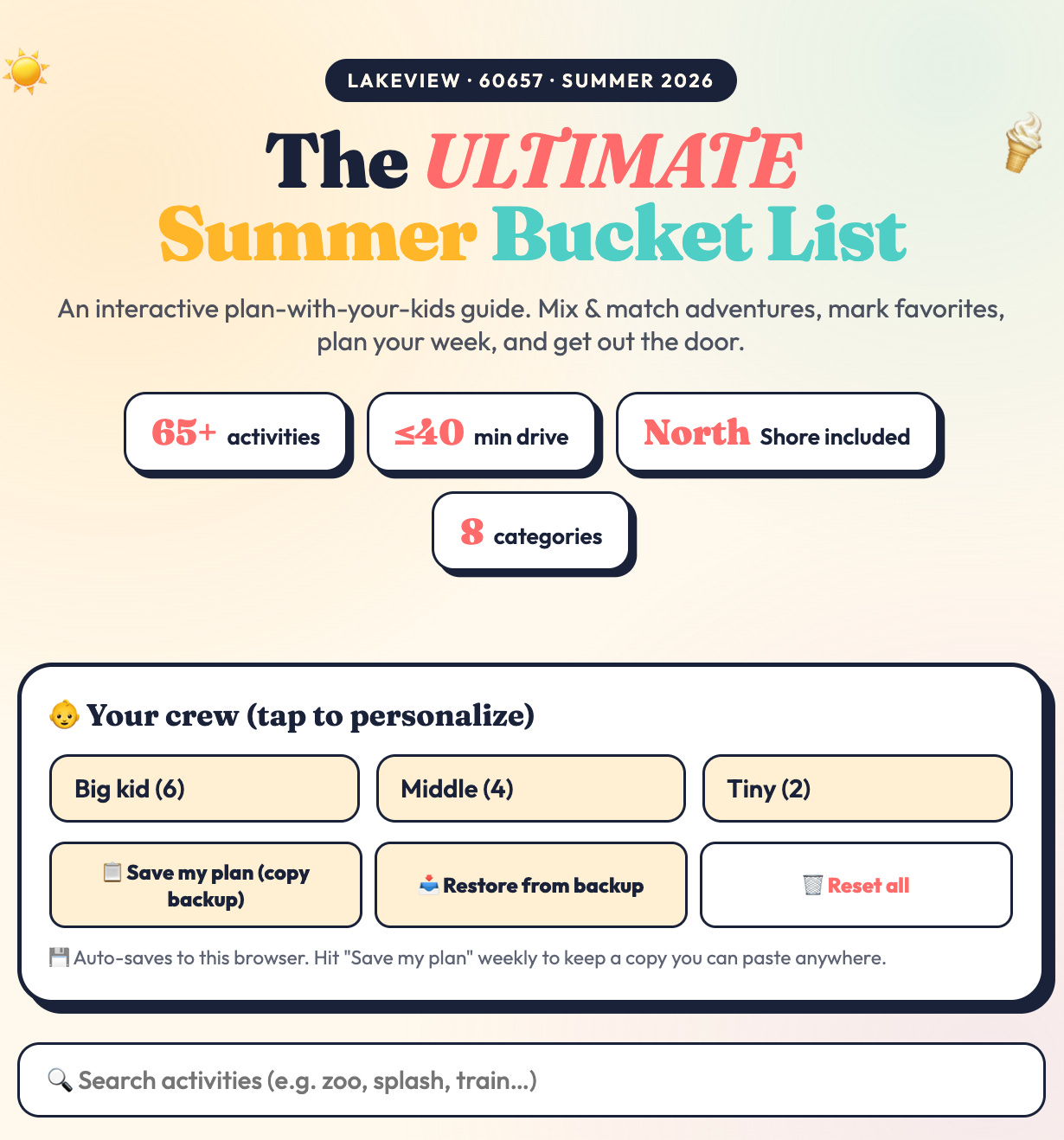
8. The summer bucket list. I gave it our neighborhood, the ages my kids are now, and 3 driving times - under 20, 20-45, 45+-1.5hrs. It came back with sixty-five things across eight categories. Decision fatigue of what do we do this weekend SOLVED. It’s also an artifact in my Claude - which means I can interact with it, keep coming back, filter for weather, which kids are joining, save which ones we have done. Kinda like a mini-app inside Claude.
Yours: name your city, your ages, and how far you’re willing to go. The best is that somebody else made the decisions and the kids get a say (if you want).
Where the guides come from.
Every Sunday I put out a guide on how to use Claude, or build an AI workflow. I don’t push those to people’s email each week, so you may be wondering what they are. Here they are if curious.
I write these too, sometimes it takes longer than I like to admit. What I don’t do is start from nothing, because the framework my guides comes from a workflow I already built and run in Claude. It puts that template into words, and I edit it from there. These four are the ones that feed it.
9. The trend scanner. It watches the areas I care about and helps me judge whether a thing is relevant or just loud. Most weeks it saves me from writing about something that doesn’t matter. I turned this one into a guide here. Yours: pick three topics worth staying current on and let it filter, instead of reading all of it.
10. The second brain. All the context lives in one place so I’m not re-explaining myself every time I start. Almost nothing else here works well without it. I wrote up how I built it here.Yours: one folder, one file about the person using it. Start there, seriously. Its the BEST.
11. Knowing what’s working. I built myself a read on my own audience: which reports to pull from Substack, what the trends are, what’s working (and not). What it told me was humbling. The practical how-to material is what people keep. The storytelling is lovely, and the thing that gets saved is the thing that changes what somebody does with their time. Makes sense, thats what I love too. This edition exists because of that.
Yours: take whatever number means success for you (at home, at work, hobbies) and ask it to analyze the last three months of data. Then run it each week, month, quarter, going forward.
12. Turning a workflow into a guide. Almost every guide I’ve published started as something I was already doing, badly and repeatedly. It’s good at finding the pattern in that, which means the messy thing done every week is much closer to teachable than it feels.
Yours: describe the annoying Monday thing out loud and ask what the repeatable version of it looks like.
If any of these twelve is the one you want built out properly, tell me which. Reply, or leave it in the comments. The ones people ask about most are the ones I turn into guides. I make sure they are actual workflows that I build and work with first.
Lastly. Don’t use it like a chat.
PLEASE don’t use Claude like a Chat. It can do SO MUCH MORE (as evidenced above). Most people open it, ask a question, get a decent answer, close the tab, then start again from nothing the next morning, which is a bit like hiring someone and firing them daily.
Build ONE repeatable thing instead, give it the context once (plz build a second brain too), and let it start to know you. The gap between people who find this useful and people who find it “fine, I guess” is almost entirely that. Context. A word I hate for a million reasons, but is valid in this case). Truth is, the second brain should have been number 1 and not number 10.
Where I stop.
More is not always the answer and I want to be careful not to write like it is. I’ve been reading Ted Chiang’s Exhalation, and one of the stories is about total recall, where people can search every moment they have ever lived. Scary. Truly. It does not go well for them. Sometimes there’s simply too much we can know, and having all of it available turns out to be its own kind of sick. I feel that way when I use Claude too much for a task, an over reliance of sorts. Which is why I like workflows for specific things and not much past that. Sometimes we really shouldn’t be using this stuff at all.
Anyway. The frogs were the highlight of the weekend by unanimous vote, and not one of them required a workflow.
I’ll see you after carpool.
Danielle